Tag: Tips

The Big Bloop

As boaters we have all experienced the dreaded sound of “Bloop”.  You know that sound that sometimes is preceded by bounce, bing, bong and then followed by the dreaded blooping noise.  It could be a one off screw, nut, bolt, favorite tool or something more irreplaceable like a ring or other item that is now bequeathed to Neptune.  Yep, perhaps even your favorite pocket knife.  

As it happens, it was a nice day and one of the warmest days here in Whangarei in a while at 21° C.  I had just finished putting down some non-slip pads under the cabin rugs below and decided to grab a beer and have a sit out back in the king’s seat at the stern of Dazzler.  My special lady saw it as an opportunity to join me and take in the warmth of the day by joining me on Dazzler’s stern seat.

We were enjoying the moment when we both heard the sound of a big bloop!  Jilly asked me if something had fallen out of my pocket.  I looked down and observed that my pocket knife, that used to be clipped to my right pocket, was missing.  The only thing visible were a few bubbles and pond rings increasing in size away from the sound of the bloop on the surface of the water just below my butt.  Well that can’t be good. 

I wasn’t too concerned about the knife because I already had a plan to attempt recovery.  I got up and grabbed my 3”x 3” magnet and started tying lines to it to lower it into the water.  Jilly kind of laughed a little and I’m sure she was thinking that I was silly for even thinking I would be able to retrieve my knife.  She then stepped it up a bit by saying that she would kiss my hairy white butt before God and everyone if I recovered my knife.  I’m sure she fully expected that she had a sure bet.  You know, that’s not something you get told everyday.  The odds of retrieval would be astronomical if we were at anchor.  But, being tied to the dock was in my favor.  I started fishing with the magnet lowering it down to the bottom which consisted of some nasty mud.  I spent about five minutes from Dazzler’s stern seat over the area where the knife had fallen into the water with no positive results.  I decided to get serious and move to the dock where I could make incremental patterns of retrieval through the water and across the muddy bottom.  

Jilly decided this was a photo opportunity and went down below to get her camera.  Just as she was sitting down on the stern seat I made my first cast from the dock into the water near the stern of Dazzler’s keel.  Once the magnet was on the bottom I started to move it slowly across the bottom.  Once the line and magnet were perpendicular to the edge of the dock I started to pull up the magnet to check it before making another cast.  

As the magnet approached the surface I observed something stuck to its bottom.  “Hey!  That’s my knife.” Jilly responded with, “No Way!” The look of amazement and shock on her face said it all.  “Oh no!”  You could even see her brain clicking on her face as she was struggling to find a way to redact her words from earlier.  I reminded her of what she had said, “I’ll kiss your hairy white butt in front of God and everyone.”  With those words echoing in my head.  I calmly marched over to the water faucet to rinse off my knife with fresh water.  As I walked along the dock back toward her, I had that spring in my step with my chest poking out like a proud peacock.  She noticed my posture and commented again about her disbelief that I could retrieve my knife from the clutches of Poseidon.  

I positioned myself in the cockpit directly in front of her, turned around and dropped my shorts right there in broad daylight in front of the entire world and I collected the debt owed me.  Jilly said she’ll never make that promise again.  

Having a proper retrieval magnet onboard is definitely beneficial for the recovery of ferrous objects.  This wasn’t the first time that I have successfully retrieved an object that blooped into the water.  It won’t work on stainless steel or other non-metallic materials of course.  A magnet should be one that is strong enough to lift a heavy tool and it should have a proper attachment point, otherwise you may just be waisting your time.  I suggest when you use a magnet for object recovery that you develop a systematic pattern that overlaps for the best success rate.  

My knife re-clipped into my pocket, a fresh beer in my hand and lipstick marks on my left butt cheek.  Ahhhhhhhh!  Does life get any better?  Nope!

Until next bloop or project take care and remember to not promise something unless you are planning to go through with it….whatever the level of embarrassment there might be.  

Cheers!

Captain Dan 

P.S. Sorry folks…there will be no photos of the butt kissing!

Happy New Bowsprit :-) and Clean New Look

Dazzler’s Bowsprit project part two.

IMG_4264 2
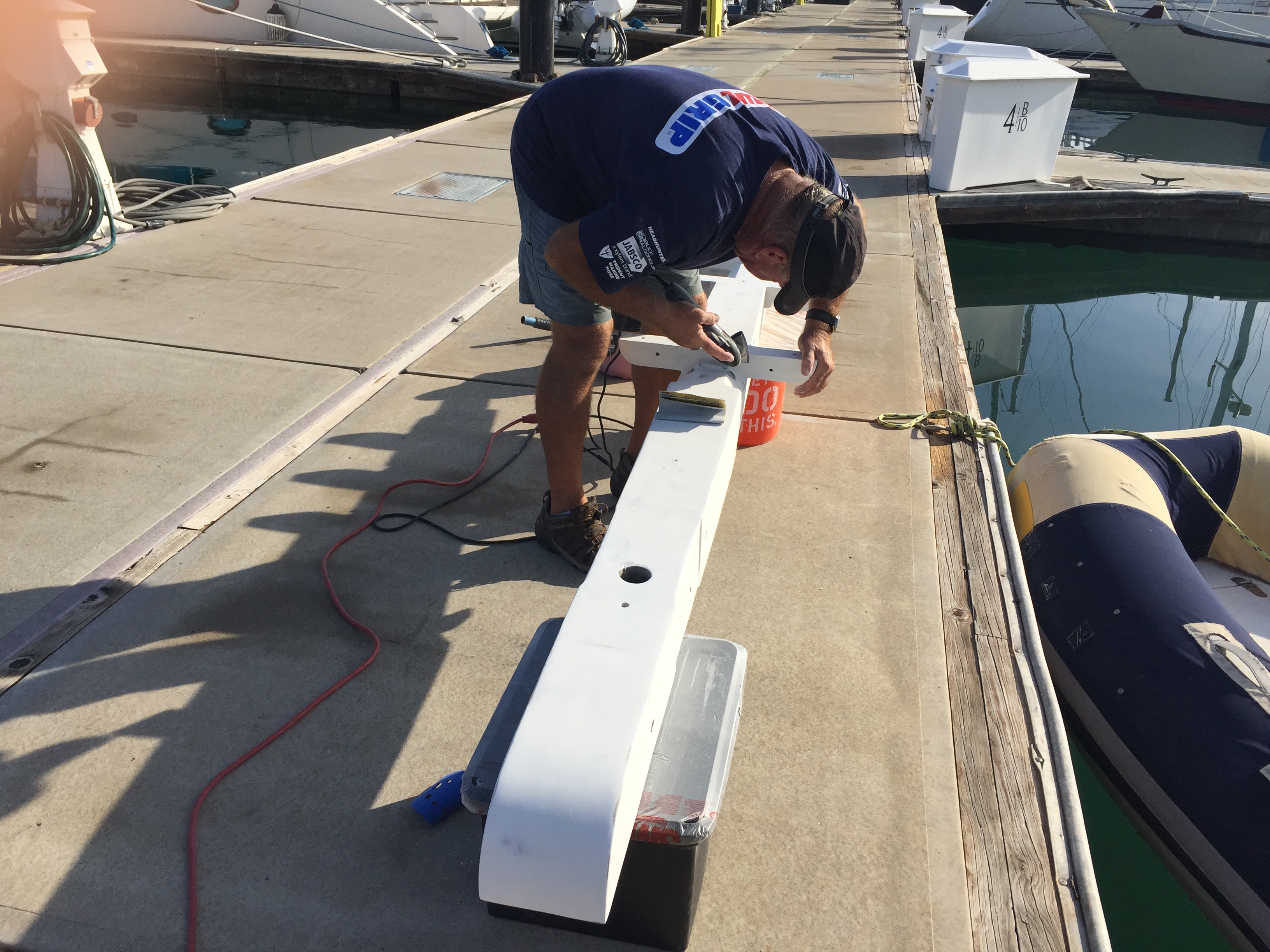
Sanding the surface and preparing for painting

After all parts removed were cleaned and/or painted, the process of re-installing parts back onboard began. While the bow pulpit was off and being cleaned, Jilly discovered a crack and hole on the lower aft corner. That was sent off to a welding shop for repairs and was returned the next day. Thanks to Haracio in La Cruz for his valuable assistance. First I set the bowsprit on the bow and bedded it with 3M 4000 bedding compound.

IMG_4275 2
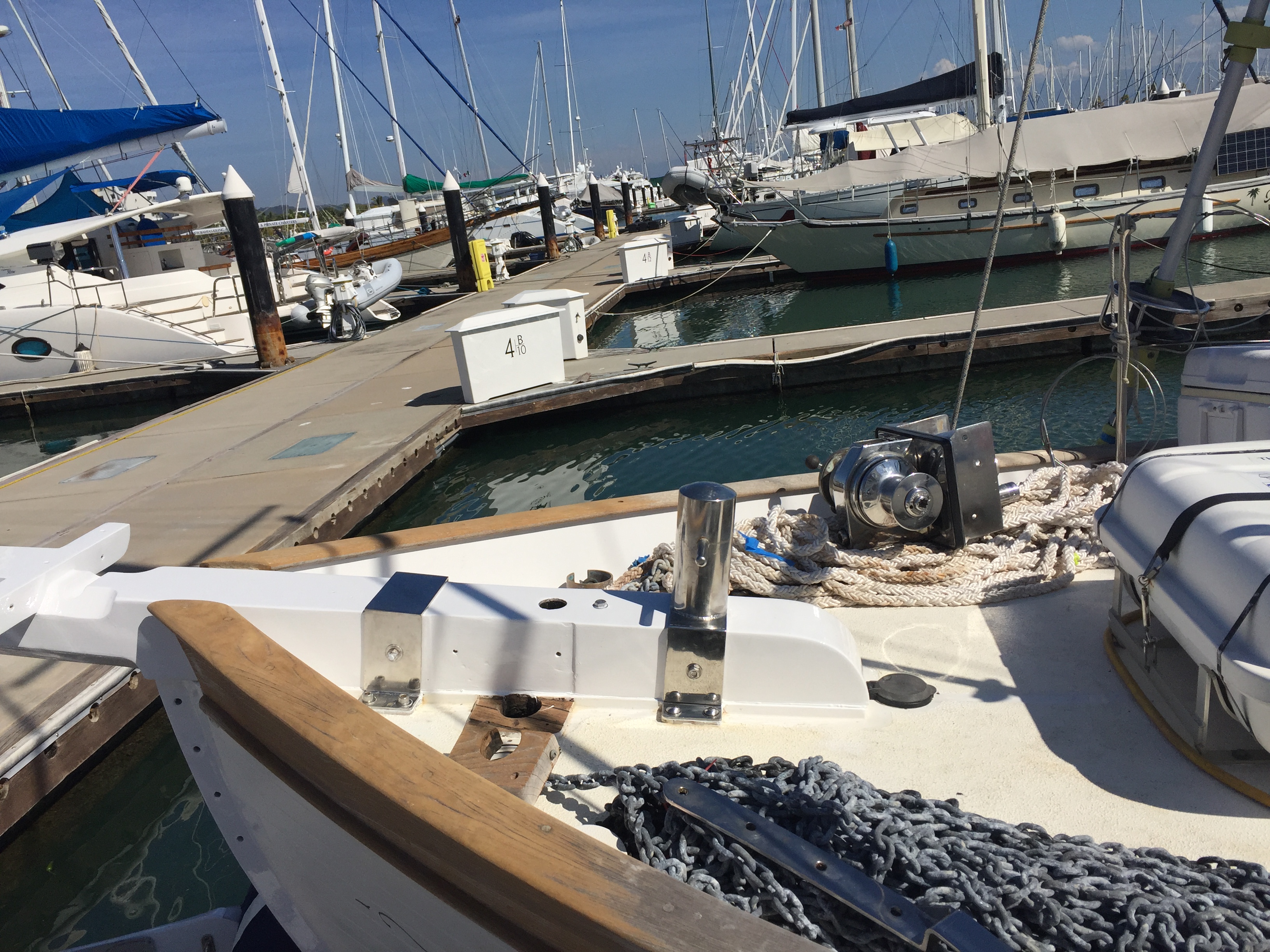
Clean Boat Bling and Cha Cha. The Sampson Post and Bowsprit strap were bedded and bolted into position.

Next was bedding the windlass and installing all of its cha cha. Next was starting to re-string the rigging. All was re-connected except for the Jib roller furling which needed its lower bearing replaced. This was a bit easier and a bit more difficult than it seemed. First the roller drum at the base of the foil came off easily. This allowed me be able to work on removing the large oil/grease seal from the bottom of the drum. The center shaft that the bearing rides on has a heavy duty circlip retainer keeping the bearing in place and preventing the shaft from riding upward. This little tidbit will be revisited later. The center shaft could then be tapped out through the top of the drum. After I cleared the shaft from the drum, another oil/grease seal and another circlip is visible and attached to the shaft. It is important to note that the two circlips on the shaft index the bearing placement on the shaft. I was able to locate the necessary replacement bearing and shaft seals locally here in the Banderas Bay area as the seals and bearings are standard type machine grade parts. There is a large circlip that insets against the interior of the drum against the outer ring of the bearing to index it against the drum housing. After removing that circlip, I was able to tap the bearing out of the drum. The ProFurl bearing and seal kit was somewhere in the neighborhood of $350 USD … if you can get one. The rigging shop in San Diego would not sell it to me because they have to be the ones that install it. I found all the parts I need here in the Banderas Bay area for approximatel $95 USD.

Ready to put it all back together, it went back together about as easy as it came apart. I recommend that you have some kind of heavy duty circlip tool for removal and re-installing the circlips. Those rings are very stout. Pack the bearing and the area between the seals with a good marine grade grease, but not too much. I used a straight probe carefully inserted between the shaft and the inner part of the seal to allow excess grease and air to escape while tapping the seal into place. I could now re-install the drum on the headsails foil. The forestay furler was attached allowing me to start tuning the standing rigging. Dazzler is starting to look like a sailboat again.

After tuning the rigging, we hoisted the staysail and furled it up. Next was the headsail. We hoisted it up with its halyard and I put the extra tug to set it in place. Now was the moment of truth. Did replacing the bearing correct the stiff roller furling of the sail? The answer was yes, but as I looked at the drum something didn’t look right. The lower shaft had pulled the top seal almost out of the top of the drum and was elevated about two inches above where it should have been. Knowing how the drum was put together, I knew that the lower circlip had some how failed. Which meant I had to de-tune the standing rigging, drop the Jib Sail and remove the roller drum, AGAIN, to take it apart.

Well, the culprit was the lower circlip was too thick and did not seat into the grove on the shaft, which allowed the shaft to slide upward when I loaded the forestay halyard. I had another circlip that was a few millimeters thinner and that was the end of that. BTW, I was able to find the heavy duty circlip at another tienda here in Mexico also. Lucky or just holding my mouth right I guess.

The double repaired drum was re-installed, the forestay roller re-attached, the rigging returned and the headsail installed again. All was good!

IMG_4309
Everything is back together and working great.

IMG_4287 2
The Guiding Star. All cleaned up, polished and ready to Lead Dazzler onto new horizons and adventures.

As part of this bowsprit project I decided to replace the stainless lifelines with Dynema material. Since I had already purchased the Dynema line, I only needed a few end terminals, which I acquired at the local Marine chandlery in La Cruz. Two afternoons of splicing and the lifelines were completed. Dazzler’s stanchions are equipped with rings welded onto them to allow the line to easily pass through. I carefully marked those locations on the Dynema and spliced Dynema covers onto the lifelines. It turned out very nice. If attempting to do these cover splices, I recommend that you complete the first cover splice and then mark where you plan to make the next cover splice. I discovered that the splice reduced the length of the line by approximately one inch for each splice.

Spectra covers at wear points
Spectra cover buried in the Dyneema Line.

The Dynema was so easy to work with and splice. I was able to remove a few splices and move the splice to the correct location. I used about 16” of Dynema cover for each splice. I also stitched each splice with Dynema whipping twine to finish it all off.

Parts List for the ProFurl furling drum and life lines

Bearing FAG #16010, this seems to be a standard number with different manufacturers

Seal Dichtomatik #39395, 80x50x12mm

Regular 3/16 Dyneema line with a breaking strength of 6,500 pounds

Johnson products were used for termination points.