Category: Hot Topics

Happy New Bowsprit :-) and Clean New Look

Dazzler’s Bowsprit project part two.
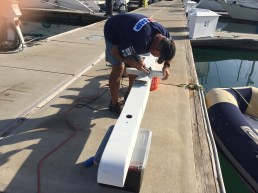
IMG_4264 2
Sanding the surface and preparing for painting

After all parts removed were cleaned and/or painted, the process of re-installing parts back onboard began. While the bow pulpit was off and being cleaned, Jilly discovered a crack and hole on the lower aft corner. That was sent off to a welding shop for repairs and was returned the next day. Thanks to Haracio in La Cruz for his valuable assistance. First I set the bowsprit on the bow and bedded it with 3M 4000 bedding compound.

IMG_4275 2
Clean Boat Bling and Cha Cha. The Sampson Post and Bowsprit strap were bedded and bolted into position.

Next was bedding the windlass and installing all of its cha cha. Next was starting to re-string the rigging. All was re-connected except for the Jib roller furling which needed its lower bearing replaced. This was a bit easier and a bit more difficult than it seemed. First the roller drum at the base of the foil came off easily. This allowed me be able to work on removing the large oil/grease seal from the bottom of the drum. The center shaft that the bearing rides on has a heavy duty circlip retainer keeping the bearing in place and preventing the shaft from riding upward. This little tidbit will be revisited later. The center shaft could then be tapped out through the top of the drum. After I cleared the shaft from the drum, another oil/grease seal and another circlip is visible and attached to the shaft. It is important to note that the two circlips on the shaft index the bearing placement on the shaft. I was able to locate the necessary replacement bearing and shaft seals locally here in the Banderas Bay area as the seals and bearings are standard type machine grade parts. There is a large circlip that insets against the interior of the drum against the outer ring of the bearing to index it against the drum housing. After removing that circlip, I was able to tap the bearing out of the drum. The ProFurl bearing and seal kit was somewhere in the neighborhood of $350 USD … if you can get one. The rigging shop in San Diego would not sell it to me because they have to be the ones that install it. I found all the parts I need here in the Banderas Bay area for approximatel $95 USD.

Ready to put it all back together, it went back together about as easy as it came apart. I recommend that you have some kind of heavy duty circlip tool for removal and re-installing the circlips. Those rings are very stout. Pack the bearing and the area between the seals with a good marine grade grease, but not too much. I used a straight probe carefully inserted between the shaft and the inner part of the seal to allow excess grease and air to escape while tapping the seal into place. I could now re-install the drum on the headsails foil. The forestay furler was attached allowing me to start tuning the standing rigging. Dazzler is starting to look like a sailboat again.

After tuning the rigging, we hoisted the staysail and furled it up. Next was the headsail. We hoisted it up with its halyard and I put the extra tug to set it in place. Now was the moment of truth. Did replacing the bearing correct the stiff roller furling of the sail? The answer was yes, but as I looked at the drum something didn’t look right. The lower shaft had pulled the top seal almost out of the top of the drum and was elevated about two inches above where it should have been. Knowing how the drum was put together, I knew that the lower circlip had some how failed. Which meant I had to de-tune the standing rigging, drop the Jib Sail and remove the roller drum, AGAIN, to take it apart.

Well, the culprit was the lower circlip was too thick and did not seat into the grove on the shaft, which allowed the shaft to slide upward when I loaded the forestay halyard. I had another circlip that was a few millimeters thinner and that was the end of that. BTW, I was able to find the heavy duty circlip at another tienda here in Mexico also. Lucky or just holding my mouth right I guess.

The double repaired drum was re-installed, the forestay roller re-attached, the rigging returned and the headsail installed again. All was good!
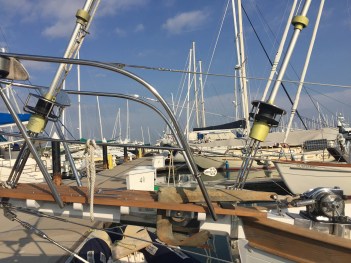
IMG_4309
Everything is back together and working great.
IMG_4287 2
The Guiding Star. All cleaned up, polished and ready to Lead Dazzler onto new horizons and adventures.

As part of this bowsprit project I decided to replace the stainless lifelines with Dynema material. Since I had already purchased the Dynema line, I only needed a few end terminals, which I acquired at the local Marine chandlery in La Cruz. Two afternoons of splicing and the lifelines were completed. Dazzler’s stanchions are equipped with rings welded onto them to allow the line to easily pass through. I carefully marked those locations on the Dynema and spliced Dynema covers onto the lifelines. It turned out very nice. If attempting to do these cover splices, I recommend that you complete the first cover splice and then mark where you plan to make the next cover splice. I discovered that the splice reduced the length of the line by approximately one inch for each splice.

Spectra covers at wear points
Spectra cover buried in the Dyneema Line.

The Dynema was so easy to work with and splice. I was able to remove a few splices and move the splice to the correct location. I used about 16” of Dynema cover for each splice. I also stitched each splice with Dynema whipping twine to finish it all off.

Parts List for the ProFurl furling drum and life lines

Bearing FAG #16010, this seems to be a standard number with different manufacturers

Seal Dichtomatik #39395, 80x50x12mm

Regular 3/16 Dyneema line with a breaking strength of 6,500 pounds

Johnson products were used for termination points.

Lithium Iron Phosphate (LiFePo4) Battery Upgrade To Dazzler

There I was all alone in the grey hues of the early morn, when the lord called my name. It was exactly like the sound of a water kettle whistling. I answered, “Yes, Lord?” and suddenly the coffee was done.

First of all, I must give credit and thanks to my good friend Dan Berkey, SV Karvi. His level of electrical theory and understanding has been a huge influence in my decision to upgrade to this new technology. His knowledge, support and assistance is greatly appreciated.

The discussion of changing existing conventional lead acid batteries to LiFePo4 type batteries began in late 2015. During the early months it seemed like more talk than an actual reality. Part of that is to due to the mystique and my lack of knowledge about LiFePo4 battery systems.

I was still in Puerto Vallarta with plans to return to San Diego, CA for some maintenance and system upgrades including a battery system change over. Honestly, the more I read and researched the LiFePo4 possibility, the more excited I became over some of the great physical capabilities of this technology.

After arriving in Southern California, I began researching everything I could about how to install these new batteries on Dazzler. I learned much from my research and information from Dan. Over voltage and under voltage protection was a must. Elite Power Solutions did sell an Energy Management System (EMS), cell sense boards and a video monitor for visualizing what the system is doing in real time. It had become clear that other equipment not offered by Elite Power Solutions had to be acquired prior to doing the installation.

Before making my installation, I decided to draw a schematic of my installation to make Battery Layoutsure I didn’t forget anything and to help in estimating lengths of wire, cable and parts needed for completion. Luckily, I have been upgrading many charging systems over the last few years. Those upgrades included a Victron MultiPlus 3000 inverter charger, Victron MPPT solar controller and a new Balmar MC 614 voltage regulator. All of this equipment has great flexibility to be configured for a wide range of battery types including LiFePo4 batteries.

We discovered several different sources of LiFePo4 battery distributors in the US. Due to open communications with Elite Power Solutions located in Arizona, we discovered that grouping a purchase of LiFePo4 batteries and related equipment could save us some $$ off the overall investment. We gathered a few friends together and discussed the benefits and potential problems with LiFePo4 batteries and we all decided to group together and increase our purchasing power with Elite Power Solutions. We decided to place the order in late September 2016. The order was freight shipped on a pallet to San Diego.

Equipment Obtained For Dazzler:

  • 4 each LiFePo4 100 amp hour battery packs
  • 4 each sense board strings that attach to each of the 4 cells in each pack
  • 1 each EMS CPU
  • 1 each shunt
  • 1 each video monitor
  • 30 feet of red and yellow 2/0 battery cable
  • 14 and 16 gauge wiring for miscellaneous connections
  • Lots of 2/0 battery lugs
  • 2 each Gigavolt GV200MA solenoids
  • 2 each Bosch style relays
  • A heavy duty positive Bus Bar

So this was my simple sketch of my instillation on Dazzler. I did not install the heavy amp on/off switches as I decided to use small on off switches to control the Gigavolt solenoids.

Lucky for me, I was able to help install Larry Camp’s battery system on His sailboat Jana located in Ensenada, Mexico. The installation took all day and occurred without incidence. The largest consumption of time was the cut to fit 2/0 cable and crimping on the battery lugs as you go along. If you are very good at measuring and cutting the cables you could probably make all of these cables prior to installation. But, due to my excellent understanding of Murphy’s boating rules. I cut and measured as I did the installation to avoid those “Ahhh Sh**” moments and the wasting of parts/materials or excess money. The Gigavolt solenoids were used as over voltage and under voltage control via the EMS CPU.

After the system was installed everything worked as expected.

Fast forward a few more days and it was time to install the LiFePo4 batteries on Dazzler. I invited my friend John Gingold of SV Silver Seas to assist with my installation as he was also going to install LiFePo4 batteries on his boat. Having all of your parts and supplies ready to go before you start saves valuable time from having to stop and run to the store for something needed to complete the installation. The installation took all day and was operating successfully at the end of the day. Again, I prefer to cut the 2/0 cable and install as I go to have a custom fit and look when the installation is complete.

Unlike Larry’s system, I had to account for four different charging sources. The Alternator, Solar power, Wind power and The Victron charger/inverter. I used a heavy gauge bus bar for connecting the charge sources and then connected it to the battery through one Gigavolt solenoid for over voltage. My Victron charger/inverter has to be run directly to the battery. The problem in doing that is it is not controlled by the EMS CPU directly. Victron technical support was contacted and through the use of two relays from the EMS CPU over and under voltage circuit, the Victron charger/inverter can be controlled simultaneously to shut off the charge function or inverter function as needed by the EMS CPU. This step allowed the Victron charger’s over and under voltage controls to be controlled by its own built in software set points.

After 10 months of operation onboard Dazzler, I am absolutely happy with the results of making the conversion to LiFePo4 battery system. I chose to make one bank to simplify the installation. It is possible to have a separate start bank, but there is some additional equipment you would need to install to isolate the two banks and charge appropriately. You can even use a lead acid start battery, but keeping things as simple as possible was my goal.

Battery management has never been easier. The fact of not having to top off batteries everyday has also added to the pleasure of power management. The voltage does stay around 13.2 volts for daily usage. All the way down to 80% of capacity. If a cloudy or no wind day happens that is no sweat for the system.

Setting the charging parameters on your different charging systems takes a little time, but well worth the investment. Balmar regulators can be setup to handle the bulk, absorption and Float charge set points with ease. My solar charge controller also had the ability to configure easily. For the last two years I upgraded charging equipment and regulators with the intent of changing to the LiFePo4 batteries. That made my investment easier because the costs were spread out over time.

Doing your homework and preplanning your system makes it much easier for installation. Yes there are some technical issues that need to be thought through. There is other charging equipment that will work with the LiFePo4 batteries, but either you or an equipment technician may have to configure your charging set points. With the Victron equipment, I was able to configure all the settings myself. I can also change those settings as needed in the future. Using older charging systems could possible add a level of frustration I did not want to deal with. Contacting manufacturer’s tech support to find out how you can modify or update older equipment for LiFePo4 may be something you don’t mind doing. I have had many instances with different manufacturers that result in finding out that my older equipment would not be compatible or not able to be modified for LiFePo4 batteries.

Last year several computer and cell phones using Lithium batteries overheated and caused fire and or damage to electrical equipment. I understand that the lithium batteries used in those applications was not as stable as LiFePo4 battery chemistry and thus are susceptible to charging, overcharging or heat anomalies.

That’s the story, the whole story and nothing but the story from the equipment installations on Dazzler.

Fair Winds, tight lines, fish filled freezers and following seas.

Captain Dan
SV Dazzler

My source of LiFePo4 equipment came from Elite Power Solutions in Arizona.

Elite Power Solutions
335 E. Warner Road Ste 3
Chandler, AZ 85225
USA

http://www.elitepowersolutions.com/contactus.html