

Sometimes the stars align perfectly and you end up at the absolute right place and at the most perfect time. This is what happened to us today.
This morning we left the Vuda Marina area and made the four plus hour trip to Wayasewa Island. It is a wonderful day on the water even if we don’t have enough wind to sail. The sun is out, there is a light breeze, the water maker is no longer leaking and all is right with the world.
On the west side of the island there are two marked anchorages on the chart. As we approach from the south we see two boats are already in the southern anchorage so we keep moving north. Soon a huge bay opens up to the east of us and we cross through the reef into a most spectacular place near Noboro Point. (pronounced “Nam boro”)

To our right on the south side of the bay we see two villages and further north at the other end of the bay we see another one. Directly in front of us is a narrow opening that separates Wayasewa Island to the south from Waya Island to the north. This northern point of Wayasewa is Noboro Point. The tide is on its way in but there is still a narrow, sand land bridge between the two. The water here is simply amazing. I’m on the bowsprit looking out for coral and I can see well over a hundred feet down in this clear azure blue water. I can see my shadow in the water and the sun is directly behind my head. It’s rays shoot out from the shadow in all directions. It’s like I’m making a sea angel instead of a snow angel. It’s so awesome! Yes the sun is perfectly set in the sky to provide me with the best possible views of the bottom and, of course, the ever dangerous coral.
We motor in toward the point until we get to around forty feet of water depth. Dan makes a few circles with the boat to make sure we are not anchoring over coral or rocks and then calls me to the cockpit. When the anchor goes down he works the bow and I work the helm. With our headsets on he can tell me exactly what to do and that keeps him on the bow to handle any trouble. Plus, let’s be honest, the anchor is heavy and even though we have the windlass (electric winch) there are times you need some extra muscle up there. My guy always does the man’s work and leaves me to do the easier jobs. It’s just one of the many reasons I love him so much.
It wasn’t long before we got our anchor set and I shut down the motor. Of course I also went below to get our anchor down beverages. No anchor down ceremony is complete without the icy cold, sweet nectar known as beer! As we sit in the cockpit we can’t help but feel a sense of peace. Here we are at this incredible anchorage and there isn’t another cruiser in sight. Oh yes! This is absolute nirvana!
After a couple of beverages we prepare ourselves to go to shore to present our kava to the Chief and ask for permission to stay.
Sometimes I have a love/hate relationship with this tradition. Yes, I truly enjoy going into the villages and meeting the people but the fact that it is “required” sometimes makes you feel like a kid being forced to go to church or school. But we always try to do the right thing as we see many others who simply do not. Like we always say… “their country…their rules! If you don’t like them. Go home.”
As you probably know by now I’m required to wear a sulu (pareo/sarong) that covers my knees and I also must have my shoulders covered. I typically wear my Dazzler’s Watch shirt but for some reason I decided to wear a T-shirt I got in México. It’s from a bar called Los Muertos. For those who don’t know, the name means…The Dead! I honestly picked it because it coordinated with my sulu. As it turns out, I could have picked something more appropriate for the day but I’m not sure anyone actually knew what it meant even though there is a skull in the design. Put it this way, I hope no one knew.
I can’t wear a hat so this requires that I do something to my hair. Since I wear a hat while cruising it’s always a challenge to make my hair look presentable. I’m sure you’ve noticed when looking at the pics from our village visits. It is what it is though so I just do my best. Today Dan decides he’s going to wear his sulu with a colorful bula shirt. It will be the first time he’s worn his sulu into a village and it will turn out to be the most appropriate time ever.
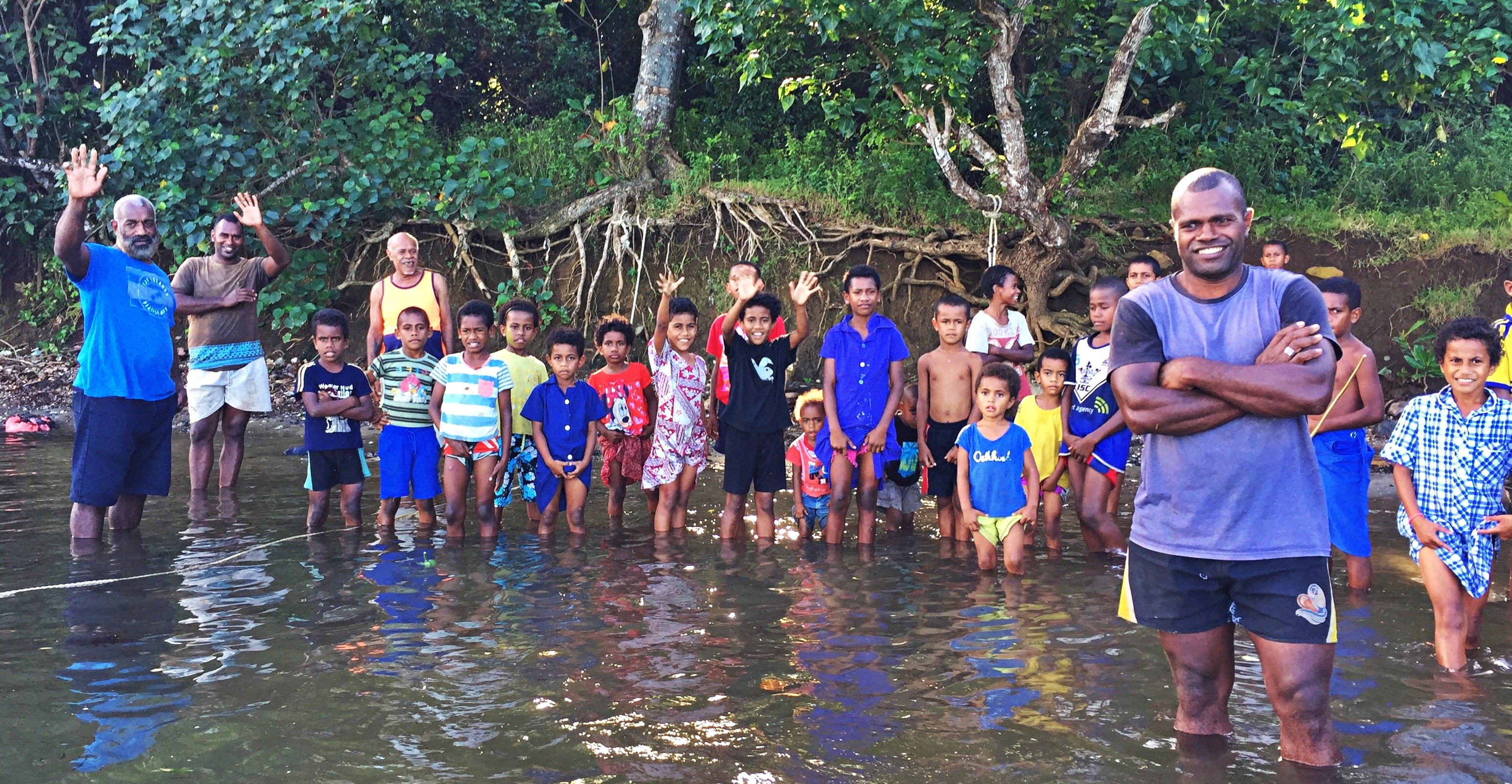
With our “approved” clothing on and the requisite kava in Dan’s backpack we jump into Sparkle and head to shore. The shoreline is covered with coral but the villagers have some buoys out that mark a small channel up to the shore. As we arrive there are two young boys, maybe four or five years old, playing in the water. Their faces light up with giant smiles as they giggle and perform silly tricks to get our attention.

It’s a steep beach so the landing is one of those ones where we have to be quick to prevent the swell from swamping the back end of the dink. There’s nothing like having to jump out of a dinghy into two feet of water while trying to prevent your sulu from getting soaked, not showing your legs and not letting the dinghy float away at the same time. Given that this is Dan’s first time having to do it in a “skirt” I’m sure it was a bit of a show for the ladies sitting under the shade trees twenty feet away.
Dan secures the anchor in the sand while I approach one of the ladies and introduce myself. She tells me her name is Nietze and welcomes us to the island. There are a couple of other ladies lying there on blankets and as I walk up they scramble to secure their sulus over their shorts. They smile and greet me with the traditional Fijian warmth we’ve come to know. With the anchor secure Dan approaches and I introduce him to my new friend. He greets her with a big smile and asks to see the Turaga Ni Koro. (Chief’s right hand man) Immediately there is a lot of talk amongst the women. It’s all in Fijian but we gather from their looks and tones that they are trying to figure out where to find him. Nietze heads off in one direction then comes back and heads in the opposite one. There’s a lot of back and forth and people calling out but before long an older man, slender and about 5’6” appears from behind one of the houses. He’s wrapping his red, patterned sulu around his waist as he walks towards us.
Dan reaches out a hand to shake his and introduces us. The man tells us his name is Sampson as he gives us a smile. His English is not very good but he likely understands more than he speaks. After all, English is the official language of Fiji and all school children must learn it. Dan asks about meeting the Chief and Sampson escorts us into a home directly behind us. He invites us in and motions for us to sit on the floor.
It’s a typical Fijian bure with no furniture, a mat on the floor and colorful material hung around on the walls and over the openings. This particular bure also has very colorful, patterned paper similar to wallpaper on the walls. The “wallpaper” isn’t glued to the wooden walls rather it’s nailed there so in places it sags from the moisture that is ever present in the islands. Sampson very quickly and abruptly asks for the kava and then says a quick prayer in Fijian. Then, in his broken English he tells us he is going to give us a tour of the village before taking us back to the school where we will have some kava. At least that’s what we got out of it.

Before we even have a chance to ask a few questions Sampson is leading us out of the bure and off we go on our tour. At this point we’re getting a pretty strange vibe from him. He seems to be a bit short with us as he’s rushing through the village pointing out the church and houses etc… We’re almost beginning to feel that this is going to be the same type of thing we experienced at Nabukeru Village but we just keep walking, talking and taking pictures. (Note that we never take the first photograph until we have asked for and received permission. It’s just common courtesy out here.)
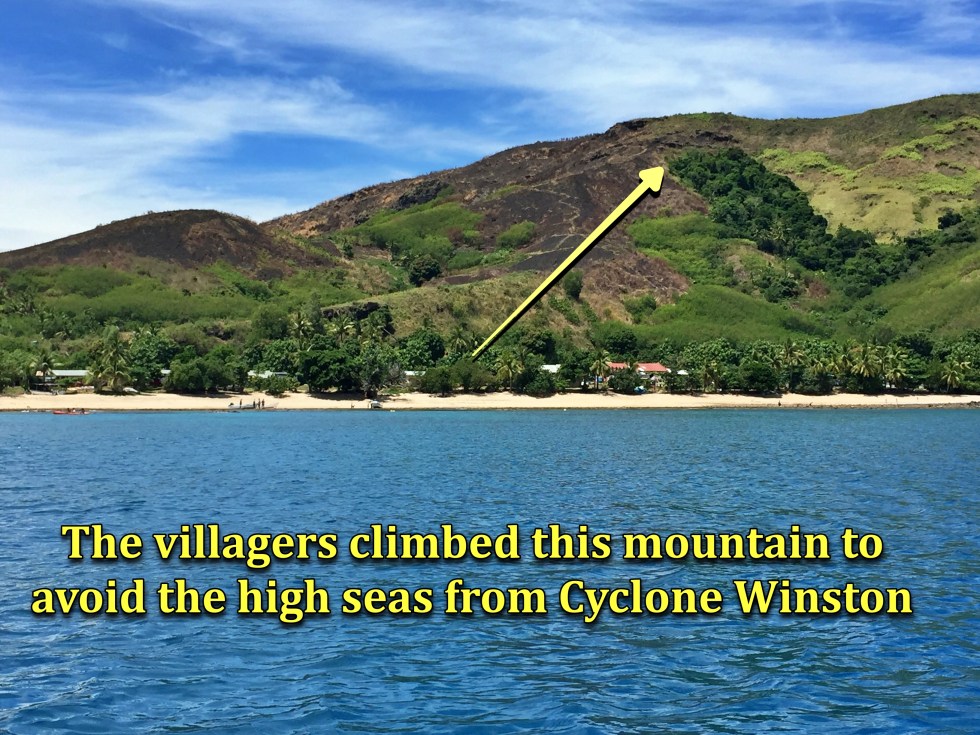
As we are walking Dan is asking lots of questions about the village. Sampson tells us that during Cyclone Winston in 2016 the village suffered extensive damage. He then points to the top of the mountain and tells us that everyone on the island went to the top of the mountain during the storm to avoid the storm surge. I’m looking at the top of this mountain and thinking two things. First, how in the heck do you get women and small children to the top of this rugged and steep mountain? Second…how terrifying must it have been to be up there with no structure for protection during the storm?

For those who don’t know, Cyclone Winston was considered the most intense tropical cyclone as well as the strongest to make landfall in the Southern Hemisphere in over 120 years. At its peak winds reached 190 mph. Over 40,000 homes in Fiji alone were destroyed leaving tens of thousands of people homeless. Over 40% of Fiji’s population of 900,000 was adversely affected by Winston and in the end they say the cost of the storm was over $1.4 billion USD.
Knowing this you can imagine the thoughts going through our heads as Sampson explains the measures they took for protection. We simply cannot wrap our heads around what it would have been like to be on this mountain with those kinds of winds whipping around. The rain alone had to feel like needles being shot into their skin. This had to have been absolutely terrifying for these people. We’re saddened to think of what they endured but once again in awe of the pure, unadulterated resolve of these people to survive in an environment that most of us would never be able to endure for a moment.
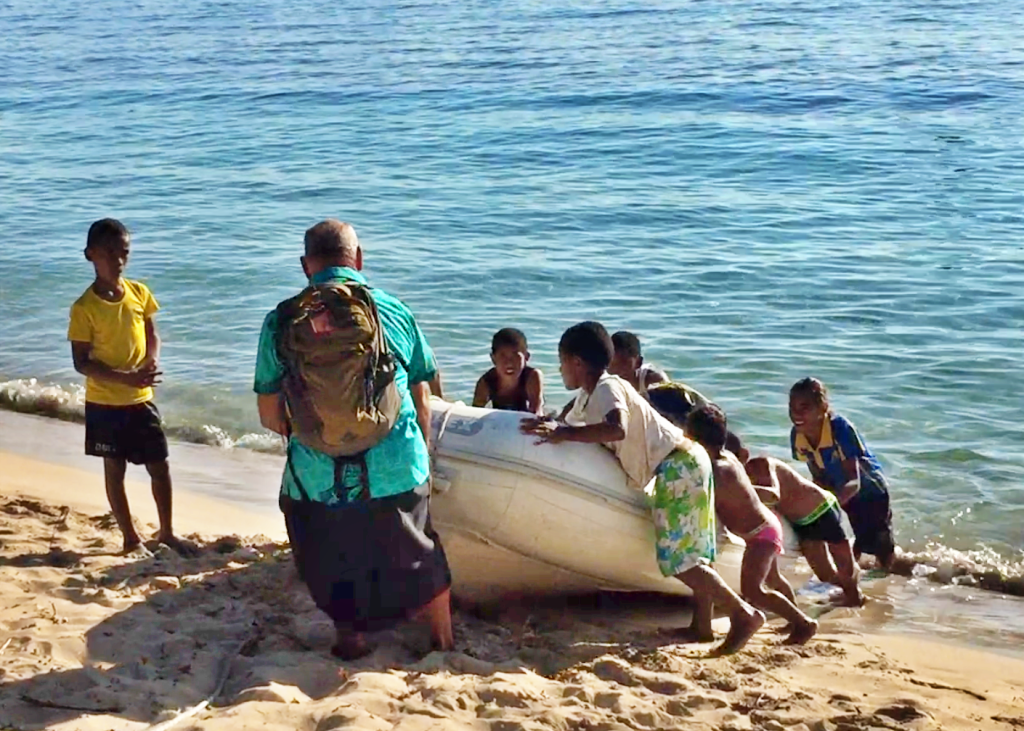
We continue our tour of the village and arrive back at the spot where we landed the dinghy. At this point we’re thinking our time on the island is about to abruptly end but then Nietze asks if we would like to see their store. Of course we say, “yes” as it is the respectful thing to do. As she runs into the house where Sampson took us to pray over the kava we note that Sparkle is crashing on the beach with each hit of the swell. Sampson starts telling the boys playing on the beach to drag her on shore. There were six or seven young boys, maybe 5-8 years old, all trying to pull Sparkle onto the steep beach. She almost weighs more than all these boys put together so Dan went to help them and together they got her secured high on the beach.

Soon Nietze comes out with her goods, lays a piece of material on the mat covering the ground under the tree and then starts putting out their wares. By now in our travels here we’ve learned the difference between locally made goods and the crap that comes from China. Most of what Nietze is putting out is from China but we do find a couple of locally made pieces and decide to buy them to help support the village.
With our purchases complete Sampson leads us off toward the school. At this point he’s becoming a bit more talkative and we sense he is warming up to us. As we approach the school grounds we see three large groups of people sitting on mats in the shade at the edge of the athletic field. Each group has a large kava bowl in front so we start to ask questions. Sampson just continues walking until we reach the group the furthest from our entrance onto the field.
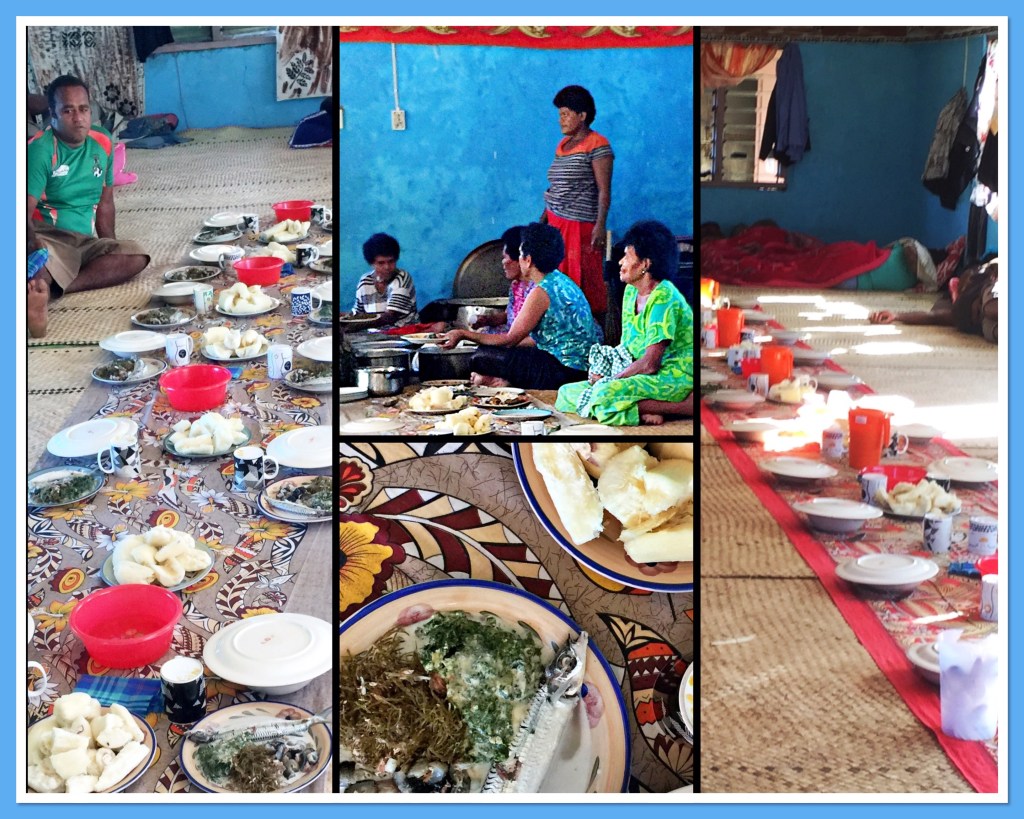
As we approach this group of people we note that there is a large kava bowl made from a round plastic fishing float that has been cut in half. We saw these same floats used to float oyster trap lines in French Polynesia. Near the front of the mat there are many men sitting around the kava bowl. Each one is wearing a colorful sulu and a bula shirt.
The women are sitting in rows behind the men. They are all wearing the same style dress only each is in a different pattern. Some of them have children with them who are wearing clothes in a pattern that matches the mother. It’s something we’ve seen a lot of here in the islands and always makes it easy to know who belongs with who.
Sampson instructs us to sit on the mat. We take off our shoes and sit down as everyone’s eyes are upon us. We say a hardy “bula”as we look around. They all reply in kind, almost in unison, as they offer up their beaming smiles. Just after sitting Sampson introduces Dan to the village spokesman, Bill. I actually think he has a more traditional name but it seems they use English names sometimes as it probably is easier for us ke pelangi (white people). Within moments of sitting Bill asks Dan to come over and sit near him. Dan greets him on his knees as is proper when meeting a village elder. They speak for a few moments and then Bill asks me to come to that side of the mat as well. I bow down and introduce myself as he tells me to have a seat. Noting the hierarchy and the way the women are sitting in the “back of the room” so to speak I sit just slightly behind Dan and the other men at the front of the women. If you are a women’s lib fanatic I would suggest you stay far away from the South Pacific islands as this is a most definitely a man’s world down here.
It’s not long before they hand Dan a coconut shell full of kava. By now we know the drill. First you say, “bula”then clap and then drink the entire contents in one gulp. Then you clap three times and hand the bowl back to the server. I’m next and the server doesn’t hold back. He hands me a full coconut shell of the muddy water as well. It doesn’t taste that bad but it certainly wouldn’t be my first choice of drink. I gulp the mildly intoxicating liquid and hand the shell back.
As we sit here partaking in the kava and speaking with Bill and the others we learn that today is a very special day for the island. This is the one day of the year that they have a church fundraiser. The reason there are three separate groups of people is that there are three villages on the island of Wayasewa. Each group represents a different village. The island is comprised of around 60 families and 200 people give or take. In front of the groups is a small table with a few of the church elders performing an accounting of the monies received. These people belong to the Methodist Church and their fundraising goal as dictated by the church on the mainland this year is $21,000 FJD. That’s a lot of jack for people who make very little.
We learn that aside from fishing and selling coconuts and pawpaw (papayas), some villagers work at the resorts on the island. There are two. The resorts pay them as little as $150 FJD per week up to $300 or maybe a little more. (That’s $75 to $150 USD) If both parents work and make an average of $225 FJD per week they only make $21,600 per year. So, the church is asking the villagers to give approximately the equivalent of one family’s yearly earnings. Like I said, that’s a lot of jack.
We also learn from Bill that the money these people make at the resorts is considered “bonus” money in that the village basically takes care of these people for all of their basic needs. They fish and eat the fruits and vegetables that they grow. They get subsidies for power etc… He made it clear that the resorts have been a very good thing for the Fijian people and they are glad they are here even though we’ve encountered ke pelangi who believe the resorts are taking advantage of them. Do we think they could pay them more? Certainly, but everything is relative and the Fijian people feel they are benefiting greatly from the resorts.

We learn a lot from talking with Bill and the others. All of the prayers and other ceremonial things we witness are done in Fijian. We would love to know what was being said. While he doesn’t translate everything, Bill is great at explaining all that is going on around us. And, as he continues to talk more people come out to participate in the kava ceremony and more and more kava is being handed to us to drink. We continue to drink and chat for a couple of hours. At one point I count 27 men and 13 women partaking in the ceremony on our mat alone. One man was missing his right leg from the knee down and his big toe on his left foot. He somehow manages to get around in all the sand and rough terrain on crutches. As we said before, these people have a resolve that is simply astounding.
It’s an incredible experience and we both love every second. Well, maybe not every second. When you are not used to sitting cross-legged on the ground it can be a bit uncomfortable after a while. Bill notices Dan fidgeting and tells him to stretch his legs out. I, on the other hand, must keep my knees covered and am stuck switching my legs from Indian style to behind me and off to one side. After all, can’t have the bottoms of your feet facing an elder and they are everywhere. My right leg keeps falling asleep and I want to yell, “For the love of God can I please just stand up now?” Of course I don’t but I dearly want to do it. The voices in my head are so loud I’m almost certain the people sitting next to me can hear them but I just keep smiling and trying to focus on the experience.
Just about the time I am ready to nudge Dan and tell him it is time to get back to the boat Bill explains that he needs to get back to his village. I take that opportunity to say that it is probably time for us to get back to Dazzler as it is getting close to dark. Bill tells us he will ask for permission for us to depart. He claps several times to get everyone’s attention and then speaks out in Fijian. A unified “Eo”(yes) comes from the crowd. We are free to leave which is good because after a dozen or so cups of kava I need two things….a head and a bed! Of course that’s if I can actually stand up without falling over on my tingling leg.
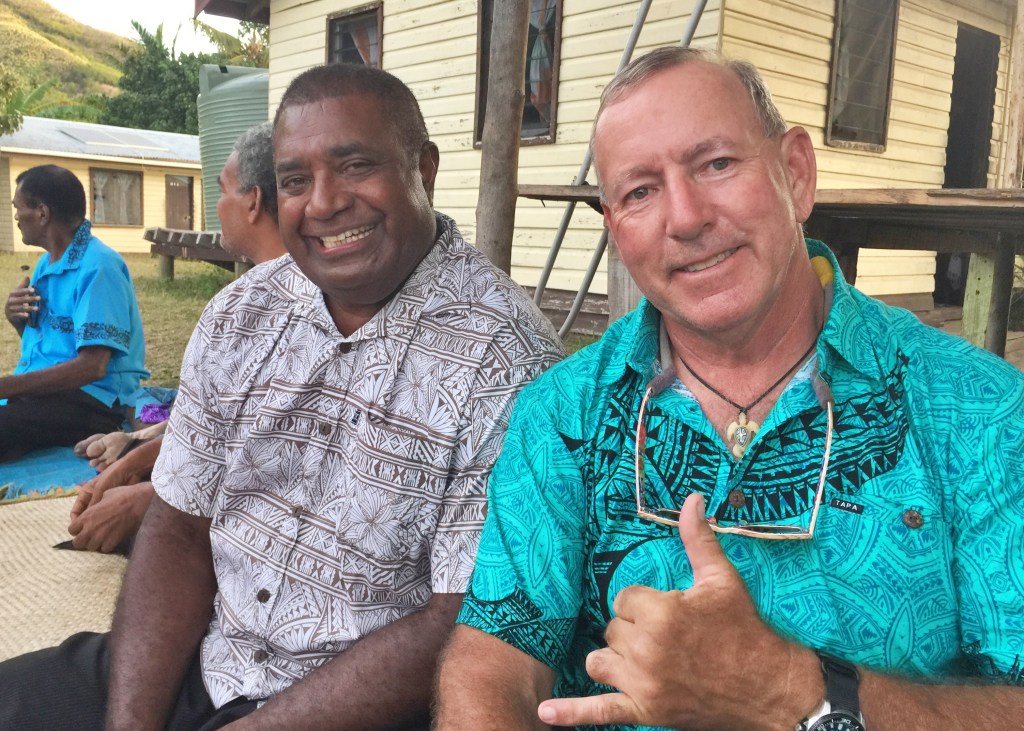
I manage to get up without falling down on the dozen or so people surrounding me. Before leaving I ask if I can get photos of Dan and Bill and also of the group. Everyone is so kind and agrees. One man is so cute he says we need to get a picture of him and me together. I can’t help wondering if he is getting himself in trouble with his wife but I agree. I do scan the ladies to see if any are scowling and it seems they all are laughing so I’m guessing it was okay. Perhaps I was the butt of some village joke or his wife was not there and they are all planning to tell her he was flirting with the ke pelangi. Either way the smile on his face made my day.
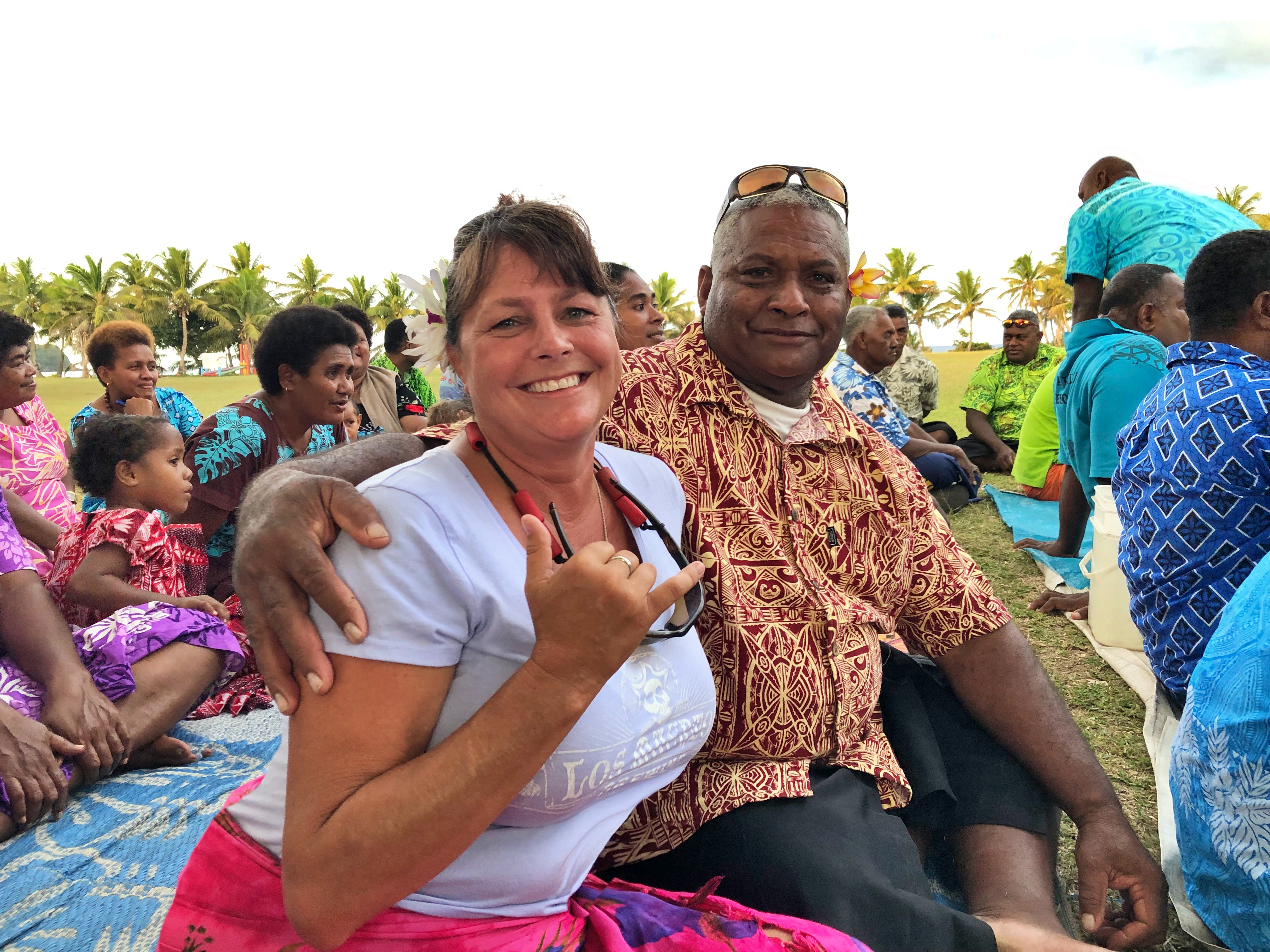

As we get up we thank everyone with a “vanaka vakalevu”. Sampson is at the edge of the mat where he has picked up my shoes and set them down for me to put on. He is quite the gentleman. The church elders from the mainland come over to thank us for being there and everyone smiles and wishes us a wonderful evening. I snap one last photo of the group as we follow Sampson down the beach to our dinghy.
On the beach I ask Sampson if I can take a photo with him. He smiles and agrees. I then give him a small hug and he asks if he can kiss me on the cheek. I say, “of course” and kiss him back. He turned out to be such a sweet man who we obviously misread initially. Looking back we’re pretty sure he was rushing us through the village tour to get us back to the church fundraiser. We’re certainly grateful for the time we spent with him.

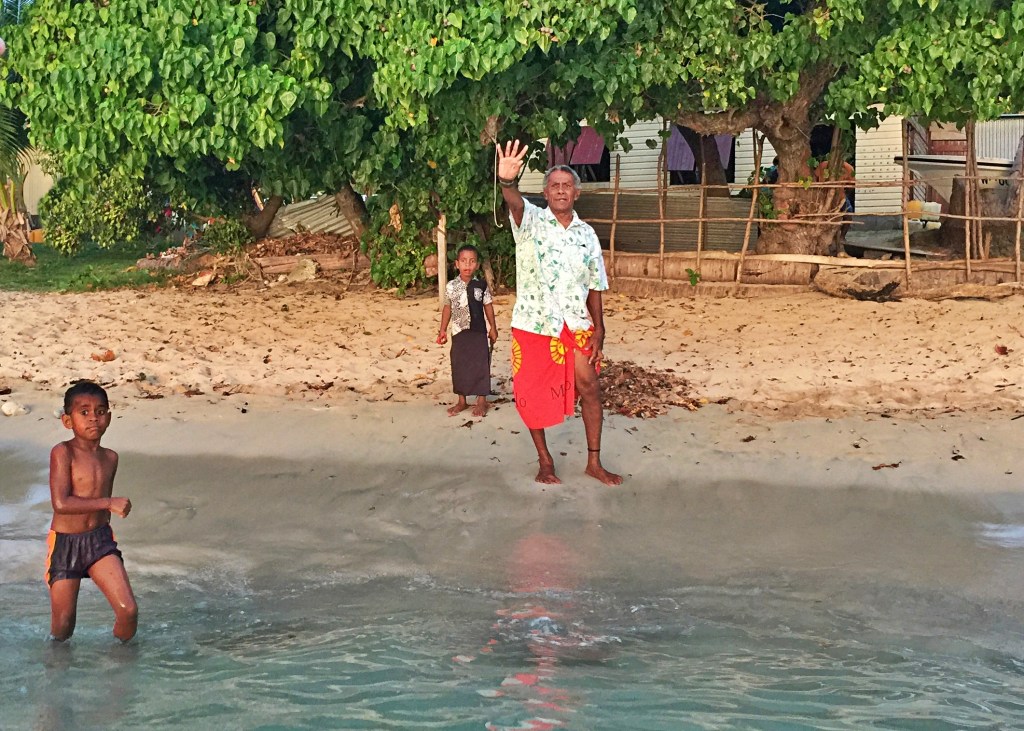
We say, “moce” (thank you) to Sampson and the young boy who help to push Sparkle back into the water and we head back to Dazzler. As we look back to the shore Sampson and the boy are standing in the golden light of the setting sun waving and smiling at us. I don’t think they will ever know how special this day was to the two of us. It certainly is one of our best days here in Fiji.
Until next time,
Jilly & Dan






 Dazzler's Watch