Month: June 2019

The Sky Is Falling In Paradise

We’ve said our goodbyes to the Fijians of Nadi Bay and are ready to hoist Dazzler’s anchor. We start Dazzler’s motor first usually to help recharge the batteries from the night’s usage. Headsets are charged and in place as I head to the bow for the anchor retrieval ritual. I’ve removed the anchor snubber and started to use the windlass to retrieve the chain. It rotates about five times and then slows to a gradual stop followed by smoke rising out of the chain locker. That can’t be good! What the H E double hockey sticks is going on? Well, using the windlass to retrieve the anchor isn’t going to happen this morning. The double gun retrieval method is employed along with the winching tool to break the anchor free of the sea floor. Great! Now I’ve got a project after we get anchor down for the evening.

Clear of the reef surrounding the anchorage we continue running the main engine for recharge. We hoist the mainsail on a path into a head wind. As we round the southeast corner of Vanua Levu we hoist the jib and finish with the engine. Nice! The sound of near silence as we sail along in paradise.

After about two hours of sailing we decide we need to drop some sail and start the engine to navigate through some reef areas along our route. Turning the ignition key results in a click followed by the electronics flashing off and then back on but no cranking of the starter. WHAT NOW?

We are now forced to sail Dazzler through the reef strewn area and into our anchorage in Bua Bay for the night. The anchorage in Bua Bay is still about 10 miles away. Not really a big deal. Jilly is a bit on pins and needles though.

I contact Lutz on SuAn to bounce around a couple of possible ideas as to what may be wrong. At the very least we know the starter has to be removed regardless of the outcome. So while underway, I grab my tools, remove the cowling around the front of the engine and start to remove the starter. About a 30 minute job. Two things for sure are now a fact. Dazzler has no way of magically starting and we have to sail into the anchorage and drop anchor under sail. Jilly’s eyes get really big about this time. And her reply is, “What?”

Well after a few hours we navigate several reefs and sail into a great anchorage and drop our anchor as planned in about 30 feet of water. Tada! Jilly was ready for the anchor down beverage at this time.

Lucky for us we have internet and phone service here and we’re able to make a few calls to a Yanmar dealer and to a place for potential starter rebuilds in Suvasuva. Once that was done, I started getting out the replacement motor for the windlass and started to get things ready for diving into that project to find out what was wrong.

First I needed to remove more anchor chain as well as the secondary chain and rode so I could access the anchor locker to remove the existing windlass motor. Done!
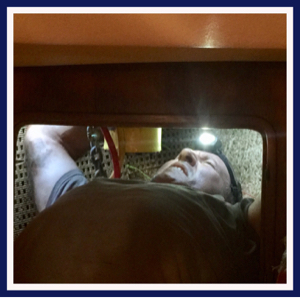
As I start working on the removal of the windlass motor I realize I didn’t have on my “Work Shorts,” and I had gotten some grease on my shorts. Jilly tells me to take those shorts off. When I start towards my locker, Jilly tells me to just work in my underwear. I was losing daylight so I jumped into the anchor locker wearing a tee shirt and my black Jockey underwear. At this point modesty was out the window.


Windlass motor was now removed and the replacement motor installed. Great. Now let’s check the windlass. Depressed the foot switch and….drum roll….nothing. Step two. Remove the headliner of the V-berth to gain access to the terminal connections of the deck mounted foot switch. I found the connections to be a little loose so I tightened them down, but it still didn’t work. Okay. I now have to pull the foot switch out of the deck and look for my spare foot switch. The one that I thought I had. Humm. After looking where I thought the switch was stored without success, I suddenly remembered possibly selling it at a La Cruz boater’s swap meet. At that time I thought why do I need an extra foot switch? I had just replaced it. Well I know that won’t happen again. I guess I’ll become a boat hoarder. That will be a new reality TV series. Ha ha ha!

Back to the repair. Knowing I don’t have a working switch, I decide to pull from my McGiver roots and make it somehow work until it can be replaced. I disassemble the foot switch to find that some heat damaged it. The warped switch didn’t allow the metal plate of the plunger switch to come in contact with the metal contacts posts. The plastic housing that the posts were set into melted a bit allowing the plunger to push the contact points further downward out of contact with the plunger plate. I needed to somehow raise the contact points upward so the plunger plate could come back in contact with the contact points. With the contact points too low, I decided to use a pencil torch against the studs to remelt the plastic around them and then tap out the bolts with a hammer. Success! Both bolts removed without cracking the switch housing. Now I took a nylon washer and cut it to fit into the opening under the contact points. This seemed to work as planned. I then needed to find out if the plunger plate would now make contact against the contact points to complete a circuit. The plunger is partially made of what looks like the same material as the case housing which means the plastic was sturdy. While examining the plunger assembly complete with a metal washer type plate and spring, the spring fell off into my hand. Whoops! That isn’t supposed to happen. Now what? I figured that I needed to reattach the spring with the metal washer plate and the plunger. I decided that a positive mechanical fix would be best. I sanded down the broken end of the plunger and drilled a hole into the end for a small self tapping screw. The head of the screw was larger than the tapered head of the spring so bingo. The screw held the spring and metal washer in place and fastened nicely to the bottom of the plastic plunger. With the foot switch all put back together a continuity test revealed some more tweaking needed to be done before it was ready for installation. It was then reinstalled on deck. Drum role please…..success!
It was now time to reassemble everything taken apart for the repair, put the tools away, have a shower and a cold one.

During some email correspondence with Curly Carswell, a long time resident of SavuSavu, for some suggestions for a starter repair facility in Savusavu. He supplied us with a contact named Paul that could rent a car, drive, 1.5 hours to Bua Bay, pick me up with our starter, drive back to Suvasuva, repair the starter and then drive me back to Bua Bay. The rental car fee would have been $135 Fijian dollars and his fee per hour would have been $35 Fijian dollars per hour. Not bad for what we would be getting. Oh yeah, Curly gets 20% of the total bill for his services.

The next morning I was up early pawing through internet sites for possible solutions and help articles. At 0600 hours, I started clearing the quarter berth of the stored equipment to gain access to the batteries and other wiring areas. At 0750 hours, I contacted Paul to arrange for his services. Our friend Lutz of SuAn suggested that I try to spin the starter with a direct wire connection from the batteries. After hooking up the starter to the batteries the test was positive and the starter was spinning. No need for Paul’s services at this point, so I immediately recontacted Paul to cancel him before he rented the car.

One of the crazy things about DC electricity is positive and negative sides of the system come from many different sources throughout the boat. Patience and good luck is required for tracking down a short or bad connection. But I knew I needed to find where the short or bad connection was located. As it turns out the windlass ground, the motor ground and the alternator ground cables where all attached to the same bolt on the motor. Looking at the motor ground cable’s connector it looked like a possible issue. Having more 2/0 wire onboard, I decided to replace both the positive and negative cables to and from the motor.

It’s about this time that Lutz shows up on Dazzler for technical assistance. It was great to have his input and between the two of us we found the culprit. A negative bus bar that was under sized for the ground wires of the alternator, windlass and the starter combination. The post that the negative engine cable was attached to had signs of heat and some melted plastic. If I’d have known the windlass ground was also attached at the engine block I’d have installed a heavy duty bus bar in this situation. Hind sight is 20-20. No sense beating myself up over it. I moved the engine ground cable to a ground post with suitable capacity to handle the loads. With the starter wired, and everything in its proper place now, it was time for the moment of truth.

I gave Lutz the honors of turning the key. Besides I was down below knee deep in tools, equipment from the quarter berth and an open engine compartment with no easy way out of the hole. He turned it over and nothing. I pulled out my phone and examined the photograph of the connected wires on the starter I took the previous day before I removed the starter. I had missed two wires from the starter switch. Oops! I reconnected the wires and once again Lutz tried to start the heart of Dazzler. Dazzler’s 45 horsepower engine sprung to life and her heart was beating again. It was a wonderful sound followed by Jilly shouting cheers of joy.

Lessons learned:
Have spare parts. The question is always which ones. There is no West Marine in the South Pacific. So, get used to the idea of if you want it…bring it with you. It is a wonderful feeling to be able to fix something without having to leave your boat. Not to mention the time needed to go get and or find something that might work.

When you have spare parts that you think you can do without and then think you should sell them at a cruiser swap meet to lighten your load…..DON’T do it! Resist the urge.

Know what equipment is or going to be grounded to bus bars and use a bus bar of sufficient capacity. Have some extra battery cables and lugs. I used a hydraulic lug crimper that I bought from Amazon for $35 USD before I left on this long journey. It is small and compact and has been used numerous times on Dazzler and helped many other sailors with cable lug crimps. Have a good multi-tester.

Take a photograph of something before you take it apart. It’s a good backup to memory.

There is always some way to fix something even if you use a pound of epoxy. I’ve said it before, if it’s broke and not working, you have nothing to lose by taking it apart to find out what makes it tick and possibly find a McGiver solution to fix it temporarily. Not trying and giving up has no chance of finding or making a solution. 100% of every short putt will never go into the hole.

In closing, I leave you with this comment. After repairs are completed and your boat is put back together with everything working again you can get back to enjoying why you are cruising in the first place. There will be days like this one and you will have to power through them to get back on track to the tropical waters, islands, indigenous people and sundowners.

I hope this will help you with similar issues and if not be sure to watch the next episode of Boat Hoarder next fall on CBS (Cruiser Bull s**t) channel.
Until the next issue of working on your boat in exotic places or part failure 101, happy cruising.

Cheers!

Captain Dan and Jilly

We’re Celebrities!

SV SuAn leaving Navatu Bay

After meeting the people of the village in Navatu Bay we were excited to visit more of these island villages here in Fiji. This is, after all, why we travel in the first place. So, this morning we hauled our anchors and set off to Nadi Bay which is just a short 20 miles or so away. We motored the entire way because there wasn’t even a whisper of wind. In fact it was so calm that it was hard to tell where the ocean stopped and the sky began but still it was a beautiful trip as we snaked our way through the treacherous reefs. I must be getting used to this whole reef business because the sphincter factor remained a cheery yellow the entire time. Either I’m getting used to it or I was so calm because SV SuAn was leading the charge and I knew that as long as we followed them they would hit the reef first. HA HA HA

We arrived in the bay shortly after noon and dropped our anchors in about 8 meters of very good holding sand and mud. There is a large reef that extends out from the shore so we had to anchor further out than normal which will make the ride in to the village take a bit. The good news is that it should keep the mosquitoes away from the boat. Most mornings and evenings we’ve had to put our screens in the companionway to prevent those nasty pests from attacking. We’ve been warned of Dengue Fever. Apparently in Savusavu they currently have 28 cases. For those who are asking, yes, you can get vaccinated against it but when we were in México and inquired about it we where told the shot would cost something like $1500 USD per person so we decided to take our chances.

Anyway, here we are in this most beautiful anchorage with a large village set on the northern shore of the bay. After enjoying a couple of anchor down beverages we set off to shore. As we approached the village there were several men in the water. One was riding a horse in the water and others were attending to a small fishing boat that was moored there. Everyone smiled and waved as we made our way to the beach.

Once on the beach we were greeted in a most grand fashion. There must have been fifteen young men in their twenties all waiting to greet us. Each shook our hands and told us their names and they all gave us such warm and welcoming smiles. One young man barely let us get on the beach before he was asking to have his picture taken with us. Yes, believe it or not, he had a smartphone and couldn’t wait to take a selfie with the Kepelangis. Of course we happily obliged.

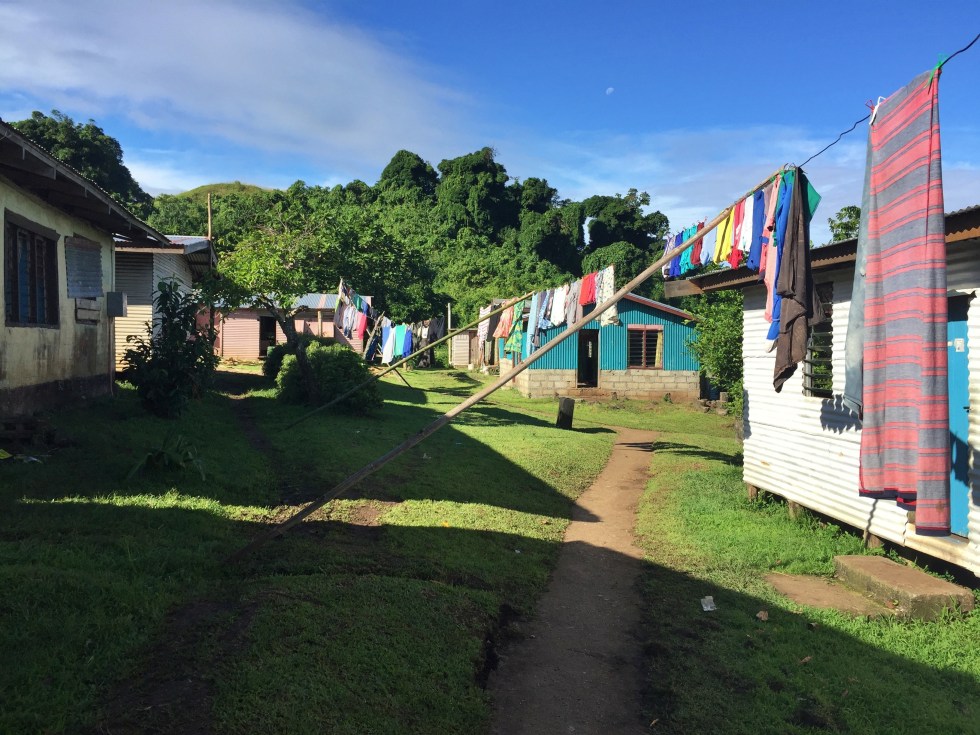
One dear young man took the lead and led us up the narrow, muddy path to the village. This village looked much like the one in Navatu. The houses are made of corrugated metal and are small with openings for windows and doors but few actual windows. There were lines and lines of drying clothes and people milling about as well as the obligatory dogs. Each person we passed stopped to shake our hands and welcome us to their village. They all told us their names but of course we met so many people we can hardly remember them.

The young man led us to the home of the Chief. We are greeted by a very pretty woman dressed in blue floral clothing. Her skirt is navy and pale blue flowers and her top is white with royal blue flowers. It’s very common here in the islands for them to mix up the prints. She was very well put together with a pretty matching necklace and earrings and she asked us to come into their home. Another woman in her late twenties or so with two small children was also inside. We can only assume she is their daughter. She was so excited to see us that she was literally beaming and jumping about giddy with happiness.

We were instructed to sit on the floor as usual and Lutz was told to place our Kava offering in front of the woman in blue. Suddenly I thought we may be in one of the rare villages where the Chief is a woman but we were then told she is the Chief’s wife and that the Chief is out working in the farm but would be home later.  After some Fijian banter back and forth between the Chief’s wife and the young man who brought us there she tells us he will take us through the village to meet the Taraga Ni Koro. He’s the Chief’s first in command who will give us a tour of the village.

We were offered a Mango flavored juice. This put each of us on edge a bit as we were told by the Health Officials when we checked into the country that we should always drink bottled water. I watched as the young woman put a powdered mix into a used plastic coke bottle and then filled it with water from their sink. Unfortunately it is almost impossible to say no to these people and quite frankly it would appear rude so we all drank the orange colored drink and prayed no one would get sick. 

We learned that the village has around 260 people in 48 homes. There’s a school here that has 130 students of which many come from nearby villages. There are eight teachers at the school and from what we saw, they are mostly men. They have solar power as usual but they are only allowed to have power from 1900 to 2200 hours each evening unless a family can afford to pay for power. Most cannot afford it.

And while we asked many questions there were two that we asked that revealed rather shocking answers. We asked how many boats come into their bay and how many of the boaters actually come into the village. Shockingly we found that so far this season fifteen boats have anchored in the bay yet we were the first cruisers to actually come ashore to the village.

As I discussed in the last article, there is a custom that should be adhered to here in the islands. That custom dictates that as visitors we are to go ashore with a gift and ask permission from the Chief to anchor in their bays. The gift is typically Kava root but could be just about anything from sugar, flour, tea and rice to books or school supplies. The point is that you don’t just come here with this entitlement attitude. This is their country and their rules and customs should be followed. Furthermore, what is the point of cruising and visiting other lands if you don’t actually take time to get to know the people there?

The fact that so many cruisers come here expecting to take and do whatever suits them is not one that sits well with any of us. It, in fact, makes us all look like rude, selfish tourists. We’ve already seen in Tonga how this has made many of the Tongans not like the cruisers at all. Our request from any cruisers making their way through the islands is to please take the time to do what’s right and customary for the locals. They are kind and welcoming and you owe it to them to respond in kind and follow their customs.

After spending fifteen or twenty minutes with the Chief’s family we were led back out through the village with the young man who had led us up from the beach. As we walk through the village we eventually meet up with the Taraga Ni Koro. He welcomes us with a big smile and handshake. He tells us he will take us up to the school. Along the way each and every villager stops what they are doing and comes out to greet us. It’s hard not to feel like some sort of celebrity as we walk along.

Just before we reached the fence at the edge of the schoolyard we stop and they show us a small greenhouse filled with saplings from a tree of which, I apologize, I can’t remember the name. They grow these trees for the seeds they produce. These reddish purple colored seeds, when crushed, produce an oil that is used in perfumes. This, along with fishing is what supports this village.

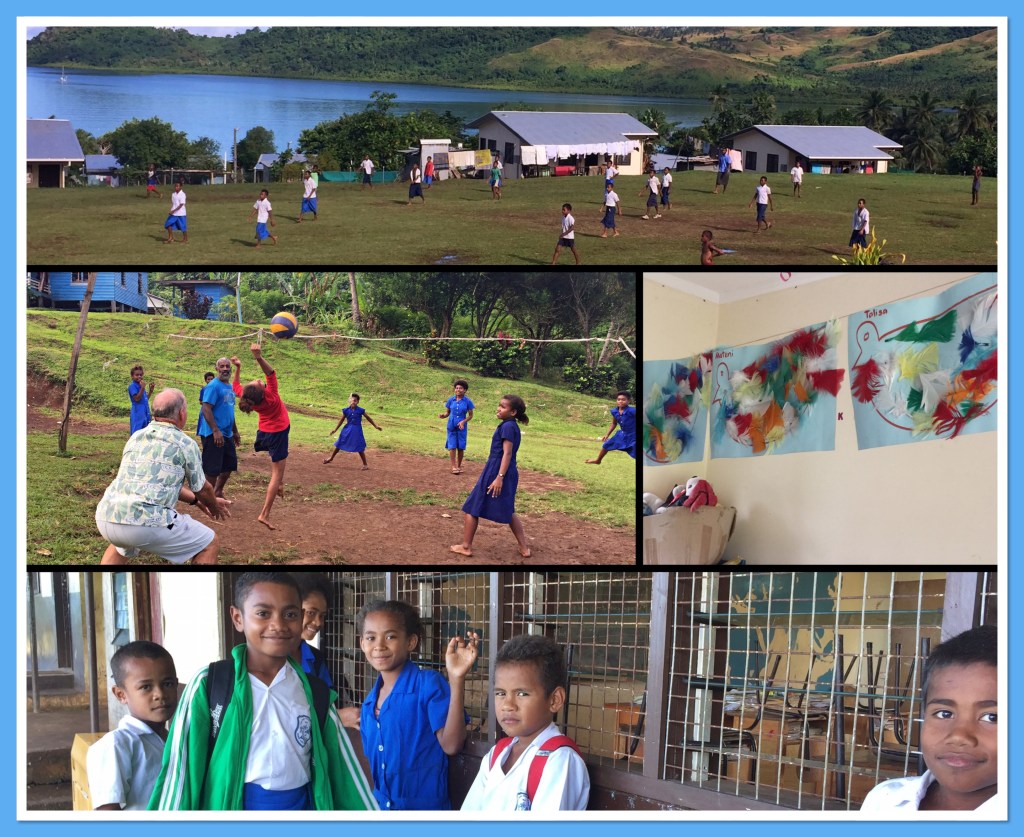
The next stop is the school. It sits on the top of the hill and is rather large compared to those we’ve seen in other villages. Of course with 130 students it has to be large. As we enter through the gate the first thing we see is a large field used for athletics. To the east end is a very torn and ragged volleyball net and it’s just near that edge of the field where there is a small building that houses the kindergarten. This is where we are led first.

The teacher here has twelve students who come to school from 0800 to 1200 each day. It’s a very small building but she has it nicely decorated for the children and just as you’d see in any school anywhere, there is artwork on the walls that was created by her students. There are three children there who are excited by our presence and begin coloring for us.

Top Left is the kindergarten teacher with three of her students. To the right the men sit outside of the kindergarten discussing the village. Bottom left is Lutz, Gabi & Dan with some of our wonderful hosts. The man in blue is the Taraga Ni Koro.

The children from the big school are let out for recess as we are at the kindergarten. Before we know it there are children covering the field. The boys are playing rugby and the girls are playing volleyball. All of them are constantly stopping to stare at the four white people at the edge of the field. Along the way up to the school Dan stops to play a little volleyball with the girls. They all giggle as he and the Taraga Ni Koro join in their game.

Further up the hill is the main school. Here we are greeted by two very nice gentlemen. One is named Mac and again, sorry, but I don’t remember the other’s name. By this point we’d met well over fifty people. We spend a half hour or so talking with them about the village, schooling and the challenges they face. One of their biggest needs is books for the children. These could be any sort of books, dictionaries or textbooks or even books meant for casual reading. They asked if we have anything like that on board which unfortunately we do not. We did tell them, however, that we will be coming back this way next year and will do what we can to bring supplies and books to their village. After all, they have all been so kind to us. If we can bring some supplies to help them, we would be honored to do so.

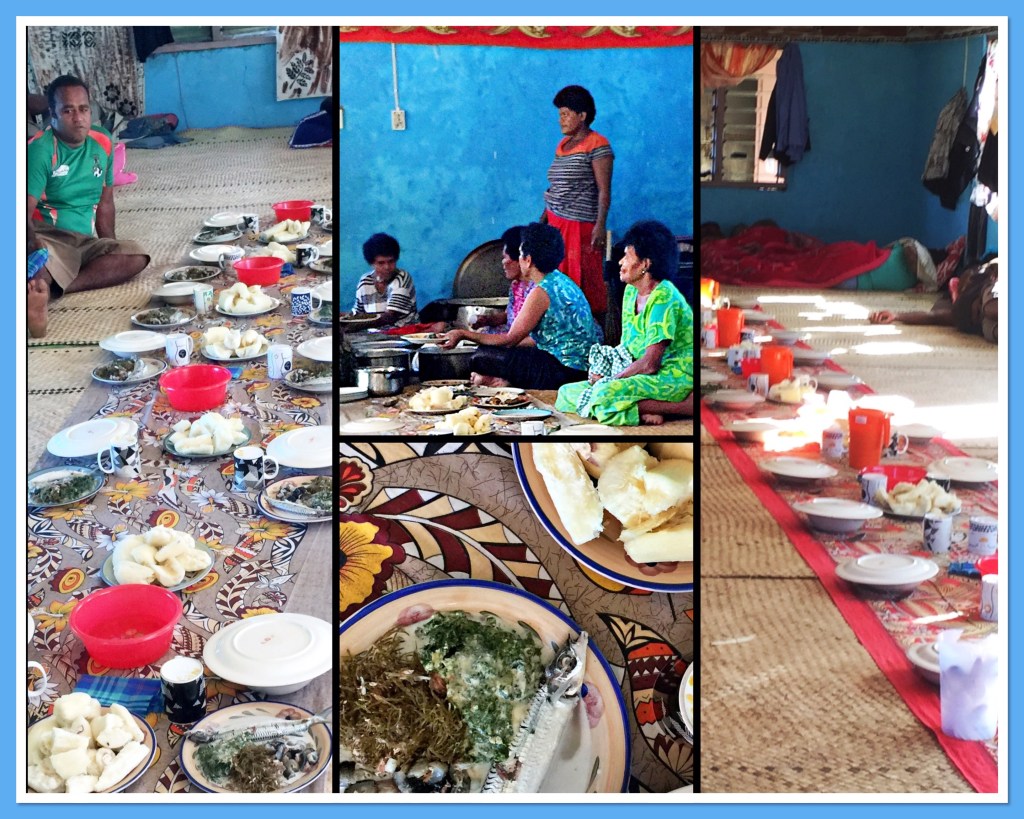
After our school visit we head back down through the village. Once again the villagers stop what they are doing to come out and talk with us. They are really too kind. Just as we are about to the end the of the village tour we come across their vorlo (meeting house). It is brimming with activity. Women are scurrying about like ants and it’s obvious something big is taking place. One woman asks me to come inside and take some photos and wow, what a treat! As I walk through the door of this long building there are women sitting on the floor on either side of the doorway. In front of them are several very large pots. Each is filled with some type of food I’ve never seen before. The only thing I recognize is fish and it’s small fish approximately six inches long. It looks just as it did when it was fished out from the ocean. It is whole and their glassy eyes are looking a bit frosted over.

The women at the pots are scooping the food onto plates and passing them to others who are then placing the plates on the long mats. It’s a well-oiled machine even though it appears a bit chaotic to an outsider. Around the edges of the room there are men sitting and even sleeping on the floor as they await the feast that is about to be served to them.

Back outside a mob of school children have found us and are all clamoring for our attention. They all want to have their photos taken. Once you take photos they immediately want to see them. I’m not sure if it is the feast about to be served or the spectacle of us but more and more villagers begin to arrive. We met one particularly well-spoken man, Benjimi, who has been in the village for several days. He and his group are evangelists there to preach to the villagers. He asks us to join them in their feast, however, the tide is dropping quickly and we need to get back to the dinghy and get out before we have to carry it across the huge reef so we thank him but politely decline.

The young lady in blue is Gracie….my helper!

It’s time now to leave these wonderful people so we are led back down the hill to the shore. When we reach the muddy, somewhat slippery part of the path I comment to Dan that I hope I won’t fall. Before I know it a lovely young lady, Gracie, about eight or ten years old, grabs my left hand and begins to escort me down the path. She looks up at me with her beautiful brown eyes and infectious smile and says, “Don’t worry, I won’t let you fall.” It’s at this moment that I realize I have reached the age where children actually think of me as elderly.  Thankfully I’m too happy to dwell on that fact now. I’m sure there will be plenty of time for that later.

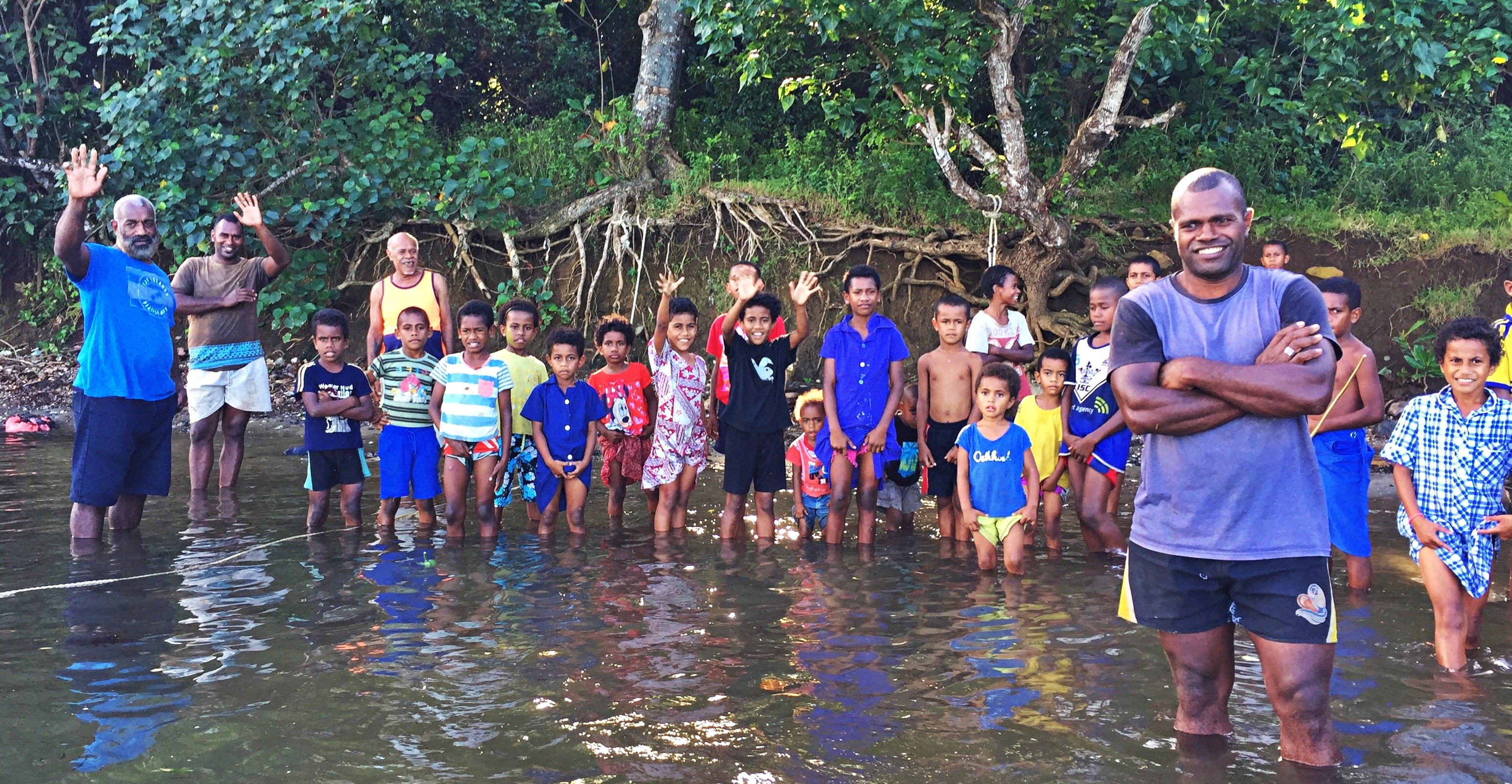
By the time we reach the shore there are probably twenty-five children and a half a dozen men there to see us off. They help us to push the dinghy out and we say our goodbyes and thank them all for the wonderful visit to their village. As we pull away the entire crowd is yelling, “moce”and waving. It is a scene I don’t think we will ever forget and I wonder as we are leaving if the cruisers who just anchor in these bays and refuse to visit the villagers really know what they are missing. 

How could you not want to come ashore and visit these amazing people?

Until next time,

Jilly & Dan