Tag: Pacific Puddle Jump 2018

South Pacific – Day#15

4.8.18 @ 1000 Local, 1700 Zulu Day #15
Location: 06°13N/127°47W SOG: 6.0 knots COG: 215°T Wind speed: 6 knots Sea State: #3 on the Beaufort wind scale (Jim the H2O is 93.2° F) Cloud: 70% BAR: 1013 Mood of Crew: Great! ! !
Jacks or Better
One of the things that I have used extensively while boating over the last fifteen years is a Jack Line. This is a safety line that is usually set up along the length of the vessel and along both side decks. It is secured at the bow and the stern of your vessel. This line is then clipped onto by persons onboard the vessel with safety tethers while on deck. The basic concept is to not be disconnected from you vessel while at sea. You may be drug through the water upside down and backwards, but you’ll still be attached to your vessel. That makes the identity of the owner easier when the boat is found.
Jack lines are made of different materials such as flat webbing or line. The line could be three strand or double braid line. Both types of lines or webbing should have sufficient breaking strength for obvious reasons. What good is the line if it breaks when you are hurled over the life lines of your boat and your tether reaches maximum length with a loud snap. See you later alligator. I have chosen to use the flat webbing for jack lines, because when you step on them they don’t roll under your feet and potentially cause you to lose your balance. There is already enough movement onboard underway without a rolling jack line.
The tethers that we use on Dazzler are flat webbing of sufficient break strength as well. The tethers are double tethers with one three foot long and the other is six foot long. They are attach to a harness or combination harness life vest. The sailing hardware used on the tethers are also of sufficient break strength and load rated. I read an article from SV Morgans Cloud that suggested that a maximum break strength should not be less than 5000 pounds to more than handle the forces involved in being hurled like a dog toy at the beach over the side of your vessel’s railing. So, I kind of used that as a good rule of thumb for our Jack lines.
Last month while performing the last minute preparations, I wanted to experiment with a different configuration with our jack lines. Traditionally, I laid the lines out along each side deck from bow to stern. It was simple and always seamed to work okay. A few articles I had read over the past several years regarding jack lines suggested rigging them off the deck about chest high and closer to the center line of the vessel. I had always wanted to attempt this configuration, because of some interesting advantages. For starters the tethers could be shortened and you wouldn’t be always tripping over your tether or getting it tangled in other rigging or wench handles, etc…. In 2009 Dazzler was fitted with a stern arch for mounting solar panels, wind generator and the antenna farm. It also makes a great platform to attach a jack line to at about chest height. I luggage tagged one end of the jack line to one of the largest tubes of the arch. Going forward with the line it passes through external handles on the outboard edge of the hard dogger, passes through the boom gallows handle forward to the mast where it wraps around the mast and is secured to a mast cleat. This configuration keeps the line off the , further inboard and at approximately chest height. One of these lines is on each side of Dazzlers cabin top. The foredeck required a bit more thought process. Dazzler’ tender is inverted onto its top on the foredeck while underway. So I decided to mount the jack line along the center line of the inverted bottom of Dazzler’s tender. I then used a luggage tag loop with the jack line and fastened it to a pad eye mounted on the bowsprit as an anchor point. Yes it is on the deck of the bowsprit, but anything higher would interfere with the running rigging of the headsail furling gear. The line passes aft over the foredeck and over the bottom of the inverted tender along the centerline and makes a few wraps around the mast and is secured to a mast cleat.
The purpose for having the chest high jack lines was to be able to use the shorter tethers (three foot long) thus shortening the distance to the side of the boat and maybe just prevent you from being hurled over the railing and drug through the water. If the tether lines are not long enough to allow you to reach the side of the boat, maybe you won’t go over the railing. Sounds good to me!
So far our daily use of the newly located jack line system and tethers has proved to be an improved fit for Dazzler. Jilly likes the elevated jack lines, because she didn’t like stepping on them and getting them tangled around her feet. I like the new configuration because when working on the main sail your tether is closer to your work and the distance to travel over the rail is now much shorter. While sitting in the cockpit the lines are elevated above our heads and this makes it easier to move and work in the cockpit while being attached to Dazzler.
One last thing, while modifying my existing jack lines for this project, the use of our handy Sailrite sewing machine made stitching in loops on the ends of the jack lines a snap. I used PTFE thread for the stitching and made the same stitch pattern as was originally used by the jack line manufacture.
Something to consider in the safety arena. That’s the way it was April 7, 2018. Have a great day!
Cheers!
Captain Dan
PS Sorry for the bad location information yesterday. It wasn’t my turn to be ring master at the circus. Jim, the air temperature is cooler than the water temp. But, the thermometer isn’t speaking with me today for some reason.

South Pacific Day #14

So if you want to test the limits and strength of your relationship, get on a boat and sail into the big blue ocean. It’s out here, when you’ve spent days or weeks together and fatigue and sore muscles abound that you really begin to know each other. You learn each other’s strengths, weaknesses and tipping points. There are days when a simple look or word can hurt the other or create feelings of frustration. Yes, this is just part of the journey.

But, in the midst of bickering over who left the coffee pot on the stove to spill or how there’s a better way to access the freezer, you get the radio call we all dread hearing. A fellow boater from the fleet is drifting and considering abandoning ship. What’s worse, it’s not because they are on fire or the boat is sinking. It’s due to a steering issue. The boat itself is solid.

As sailors we all agree on one thing; you never leave your vessel until the last possible moment. As one dear friend, Ray of SV Seanote, said to me, “You never step down into a life raft. You step up into one.” This means you don’t get off until getting off is the only thing that keeps you above the water.

That said, simply drifting at the whim of the sea with no ability to control your course can also be very dangerous. With just the right set of swells and wind to hit you broadside your boat could roll over and begin taking on water. A truly good sailor knows how to heave to. This is essentially parking the boat in the ocean. You steer headlong into the wind and set your sail and rudder just right and voila you almost stop the vessel from moving. Sure, it still drifts a little but it stays well positioned in the sea. This can prevent a rollover and you can literally stay this way for days.

The vessel in question here is SV Aftermath. She’s a Canadian flagged vessel with a Captain, John, and two crew aboard. They’ve been literally plagued with issues since they left Banderas Bay about ten days ago. First their spinnaker got tangled in their rigging, then the HF radio was causing the autopilot to do crazy Ivans, then a leak in the hydraulic lines to the autopilot and now the whole thing has seized up leaving them with only an emergency tiller to use for steering. The problem with that is it’s in the aft cabin so you can’t see where you’re going and steer at the same time. If you’ve ever tried to hand steer a sailboat in rough weather you know that it’s critical to be able to see the swells and watch everything going on around you. Yes, it’s a bad design but it’s what they have to work with right now.

Unfortunately for John his two crew members have had enough fun and want to get off the vessel. As you can understand, it’s not that easy. Yes, there are other boats coming through but we all have limited space and provisions on board and since their lives are not in immediate peril, it’s not really something many are willing to take on. I mean, we would have turned in a split second if she was sinking, but asking us or any boat for that matter, to reverse course and beat into 8’ – 10’ swells and 20 knot winds just because two crew members don’t want to do the hard work is a bit much. When you step onto a boat making this sort of passage you are accepting a level of responsibility and loyalty to the Captain and the vessel. You can’t just jump ship because it’s not fun anymore.

And that’s only part of it. There’s the risk to the “rescuing” boat and her crew as well as to the crew hoping to get off of Aftermath. Let’s face it, out here you don’t just pull up alongside the other boat and have them step onto yours. No, this is not a redneck yacht club. This would involve putting those crew members in the water and that is dangerous no matter how you do it.

Nonetheless, Captain John put out a plea on the net last night asking if anyone would be willing to take his crew. We heard crickets! Perhaps because Captains wanted to consult with their crews or perhaps for the very reasons I’ve previously stated. Either way I believe his crew needs to suck it up and do what needs to be done.

There’s another component here I’ve yet to mention and that is if the crew gets off, Captain John is left to single hand this vessel some 1400 miles. It would be difficult at best to do it with crew aboard when you could have someone in the cockpit telling the person at the tiller where to steer, but to have one person trying to do both is just not a good idea. Add in the fatigue factor and this is a very bad idea in any terms.

On the net last night Dan as well as Ernie, the Captain on SV Patience tried to talk to John about the dangers involved in trying to single hand his vessel in its current state. John listened but I’m not sure, if in his state of extreme fatigue, he was really processing it. “I know it’s a risk but I’m just not ready to give up my boat.” John told Dan over the radio. John built the entire inside of his boat and so obviously he’s got his heart and soul into it and it sounds to me like he’s thinking with his heart, not his head. In the end, she’s just a boat and we all have to be mentally prepared to leave our homes if and when the time comes.

There is an entire fleet of vessels out here hoping and praying they are able to get Aftermath into port yet most of us are thinking the same thing. At some point you have to be prepared to cut your losses, contact SARS (Search & Rescue) and scuttle the boat. For now, no one has stepped up to take on his crew so they are stuck in their situation. It’s our hope that they will step up, dig in and do what needs to be done to get them through it. Quite frankly that’s the best option for all involved.

We’ll keep you posted on what transpires with SV Aftermath and her crew. In the meantime, keep them in your thoughts and prayers, I know we will be.

Until next time,
Jilly

P.S. I guess it goes without saying that we quit caring about the spilled coffee and the freezer. After all, we are together and safe on Dazzler, what is there to bicker about?

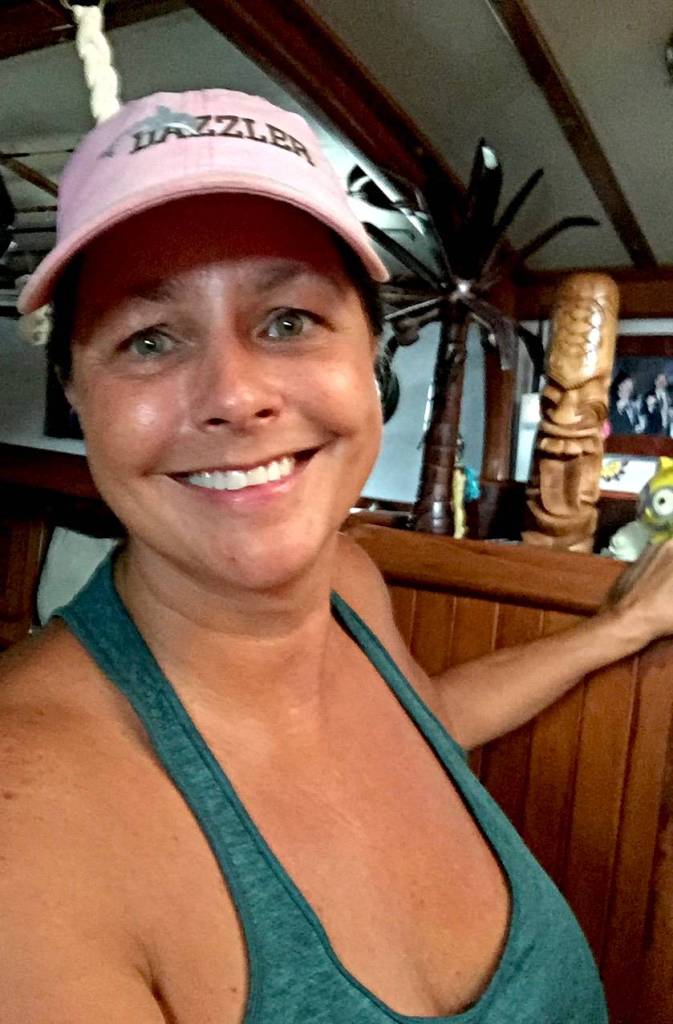
P.S.S. As you can see we are experiencing some rain and squalls. For those asking themselves why I’m happy and dry while Dan is in foulies and chilled to the bone, let me say I was that way at 4 a.m. I have since volunteered for watch duty again but Dan refused saying only one of us needs to be wet and miserable. You see, even on Dazzler it’s not always sunsets and cocktails.