
4.17.18 @ 1700 Zulu Day #23 Latitude: 05°57 S Longitude: 136°141W Covered Distance Last 24 Hours: NM Distance to the Marquesas: 273 NM Distance from Punta de Mita, Mexico: 2952 NM Weather: 84° Winds: E 15 Knots Sea State: E 1’-3’ Sea Temp: 84° Air Temp: 84° Course: 206 T Speed: 5 Knots Barometer: 1013 Crew’s Mood: Doing laundry … What do you think?
Boy, the Captain Ron saying, “If it’s going to happen, it’s going to happen out there.” may possibly be the most accurate saying you’ll ever hear in boating. Approximately 50 – 60 boats planned to leave Banderas Bay on the Pacific Puddle Jump this year. As of now somewhere around three dozen or so are either underway or have already reached French Polynesia and it hasn’t been smooth sailing for everyone. SV Epiphany was 350+ NM offshore when they were forced to abort and return to Mexico due to a battery issue. SV Patience experienced issues with his spinnaker, his crew and more importantly with his engine just before he reached the ITCZ which is where you definitely want your engine to work to get through the doldrums and dodge squalls. It took him almost two full days to diagnose and fix the heat exchanger issue. SV One Fine Day experienced a leak in a pump as well as radio issues. Even here on Dazzler we had an issue with a seam separation on our mainsail, a fouled roller furling and worst of all, a broken shackle at the head of our jib that sent it crashing into the sea.
And we can’t forget SV Aftermath. If you’ve been following our journey you know the issues that have plagued them. If not, I encourage you to go back to Day 14 where I first discussed some of the many issues they have had along their journey. I’ve been writing a lot about SV Aftermath but not because I’m trying to be critical, rather because I think there are many lessons to be learned from their situation; in fact, from all of the issues we’ve all faced out here. The truth is, mariners we all hope and pray we will never be faced with really tough problems or equipment failure at sea but we need to think about them before they occur. That’s part of the “what if” practice we all should employ on a regular basis. By analyzing what others have done right and wrong we can learn and create our own plans for how to handle things at crunch time.
So let’s talk a bit about what we’ve learned from this passage so far. The absolute first thing that comes to mind is preparation. Many people would walk by our boat in La Cruz and make comments about how much work we were doing to get ready for this journey. They always seemed shocked that we had so much to do. Let’s be clear, it’s not that there were a bunch of repairs that needed to be made. No, the bulk of the work was “preventative maintenance “. You know, addressing potential trouble spots BEFORE they become issues? Murphy’s Law as well as Captain Ron tell us if it’s going to happen it will happen at the worst possible time…like when you are hundreds or thousands of miles from shore. There are enough things that have the potential of going wrong out here so why not try to mitigate things by limiting the number of possible future issues? The problem I see is there are too many sailors who take the opposite approach. You know, the “Oh shit it broke. Now I need to fix it.”ones? I guess that’s an okay thing if you’re a marina queen or never venture far from shore but if you plan to make a passage such as this one, it can certainly come back and bite you. And, failure on your part can make you a burden to the entire fleet as you may require assistance in the form of parts, supplies or even an all out rescue.
Yes, preparation is the biggest lesson I think we’ve learned out here. And in preparing, you need to make certain you have extra parts for everything because if anything is guaranteed out here it’s that something will break and you’ll need to be able to repair it or face the potential loss of your vessel.
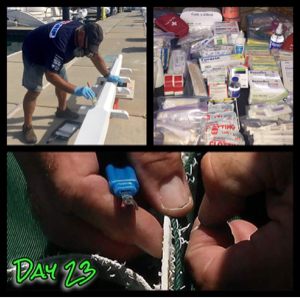
I often give Dan a hard time about the fact that I’ve only got one locker and two drawers for clothes but when something goes wrong and he magically has the part to fix it; I realize having spares and using our space to keep them is the most important thing we can do. Just like the other day when he, out of nowhere, came up with a shackle for the jib. If he didn’t keep all these spares, we’d be one sail down at this juncture.
For me, preparation goes beyond just disaster planning, preventative maintenance and spare parts though. After all, you can have someone work on your engine, rigging, radio etc…And, you can have all the spare parts your vessel can hold but if you don’t know what to do with them, they are nothing more than really expensive paperweights. My daddy always said, “If you’re going to own a boat you better be very handy or very wealthy.” Personally out here, I’ll take the handy guy all day, every day! You need to know your vessel inside and out. Just yesterday I woke up to find Dan in the cockpit with the generator apart. It had stopped working and we use it everyday to supplement power. It took about an hour but he got it fixed. When I ask Dan how he knows how to fix a particular thing I always get the same answer, “It’s because I have worked on every part, system and piece of this boat, what I didn’t know, I read about and learned how to do.” And it’s that which allows him to fix everything on Dazzler. Even if we don’t, which is rare, have the correct spare part, he knows the item in question well enough to be able to rig something that will work, It’s that type of thing that can mean the difference between continuing on or calling for rescue.
The second thing we’ve learned is that it’s important to keep in contact with others traveling around you. If your group has a radio net I highly encourage you to participate. And by participate, I don’t just mean, check in. Step up and become a net controller or step in to handle relays when necessary. Sure, these people may be a couple of hundred miles away but they just might be the closest vessel to you if you’re In need of assistance. Not one, but two vessels have diverted course to assist SV Aftermath with their water shortage and when they thought they needed oil, SV Nightide joined us in diverting course to assist there as well. Yes, keeping in touch with the fleet and being up front about the issues you are having is critical. This is no place to be shy about what you need nor is it a place where you want to try to be a hero.
And, when things start to spiral out of control, you have to be ready to bring in the big guns. SARS (Search & Rescue) is NOT the last ditch call you make when things go all furdaggled. They should actually be one of the first calls you make. “Why would I call SARS now? I’m not ready to give up hope and abandon my vessel.” Well, here’s the thing. If you call before you have reached the point of no return then you give them time to appropriately prepare to do the best job they can to help you. In the case of SV Aftermath, that is what is transpiring at this very moment. JRCC Honolulu, the SARS coordinator, is aware of their plight and monitoring them. In other words, Aftermath is on their radar. They are keeping constant tabs on their location as well as the situation on board. Several days ago Peter at Northland Radio (Pacific Seafarers Net) requested a list from Dan of all PPJ vessels within 200 NM of Aftermath. Why? He is providing that list to JRCC so they know who is closest and could possibly render assistance if an urgency or distress call does happen. This way, they are not behind the proverbial eight ball when or if the time comes that immediate assistance is needed. You have to remember that out here, we are not easy to reach and definitely not easy to find. Even with all the electronics and doodads we are still just tiny specs in a giant ocean. If you’re in trouble you want anyone and everyone to be looking for you.
I personally believe there are three reasons why mariners avoid contacting SARS. The first is out of embarrassment. They feel it shows weakness and an inability to handle their vessel. The second is fatigue and the fact that their minds are not fully comprehending the gravity of the situation and the third is plain ego and arrogance. We all know a captain like this. You know, the one who believes they are invincible? For every captain like that there are hundreds of stories of how a captain and his crew lost their lives because their leader failed to acquiesce and do the prudent thing. If you are one of those captains and I’ve offended you, I offer no apology as it is my firm belief that you are a danger to yourself, your crew, fellow boaters and even the professional search and rescue teams who will ultimately have to try to save you when all hell breaks loose and you can no longer control the situation.
In my eyes the best captains are those who recognize not only their own limitations but those of their vessel and their crew. Just because you think you should be able to handle a situation, fix a broken system or weather a severe storm does not make it so. By recognizing those limitations you can make prudent decisions as to the only thing that matters…the lives of you and your crew. Your vessel can be replaced…lives cannot. One thing that really gets to me is when I see a captain focus on saving their vessel before they consider the fact that they are putting themselves and their crew in a perilous situation. Don’t get me wrong. I’m not saying you should abandon ship when problems first arise but at the very first moment the problem rears its ugly head it is incumbent upon you, the captain, to assess the entire situation. Micro focusing on the broken part or system and failing to look at the big picture can be disastrous. For example, if the issue at hand could potentially delay your journey by days or weeks, you need to stop and asses things such as provisions, water, medicines, etc… Do you have enough to make it? If not, then you need to address the potential deficiencies immediately. How you do this depends entirely upon your situation. Are are traveling within a reasonable distance of other boaters who may be willing and able to render aid? If yes, then you should immediately reach out to see what help is available and you need to be brutally honest about your plight. Don’t try to make things appear better than they really are because withholding valuable details will only hurt you in the end. Contacting fellow boaters, however, is not enough. You also need to make that call to SARS and if you, the Capitan, are not ready or willing to do it then I encourage your crew to step up and do it for you. It may just save your lives!
In the end, at least in my opinion, preparation, communication and the willingness to call in the professionals are the three biggest lessons I’ve learned on this journey. If you are going to commit to making a passage like this you need to think seriously about all of these things. Like I said earlier, the only guarantee you have out here is that something will go wrong. How prepared you are to deal with it could mean the difference between reaching your destination or abandoning ship.
And I’ll leave you now with something a new friend on SV Dash said in a message to us today…. “Luck is where preparedness meets opportunity.” Hmmm…there’s just something so profound in those words!
Until next time…
Jilly
P.S. For those wondering about SV Aftermath they are still limping along at 2-2.5 knots. If they can keep that going they could potentially make landfall at Nuka Hiva in another 25-30 days. Water, however, will remain an issue as the 25 gallons (a mere eye dropper full in the scheme of things) delivered to them by SV Harlequin will only buy them another 15 days or so. With more and more vessels in the fleet pushing further south and many making landfall there are less out here to come to their aid. If they can’t get water they may be still be left to abandon ship. We’re still praying for them and will keep you posted.
 Dazzler's Watch