

Vanuatu, originally named New Hebrides, is believed to have been first inhabited by people over 3300 years ago. Archaeological evidence has shown that the Lapita people were the first human settlers in the South Pacific. These settlers arrived from Taiwan migrating through Papau New Guinea down to Vanuatu and when they did they brought with them tribal customs, Kastom dancing and many ancient traditions.

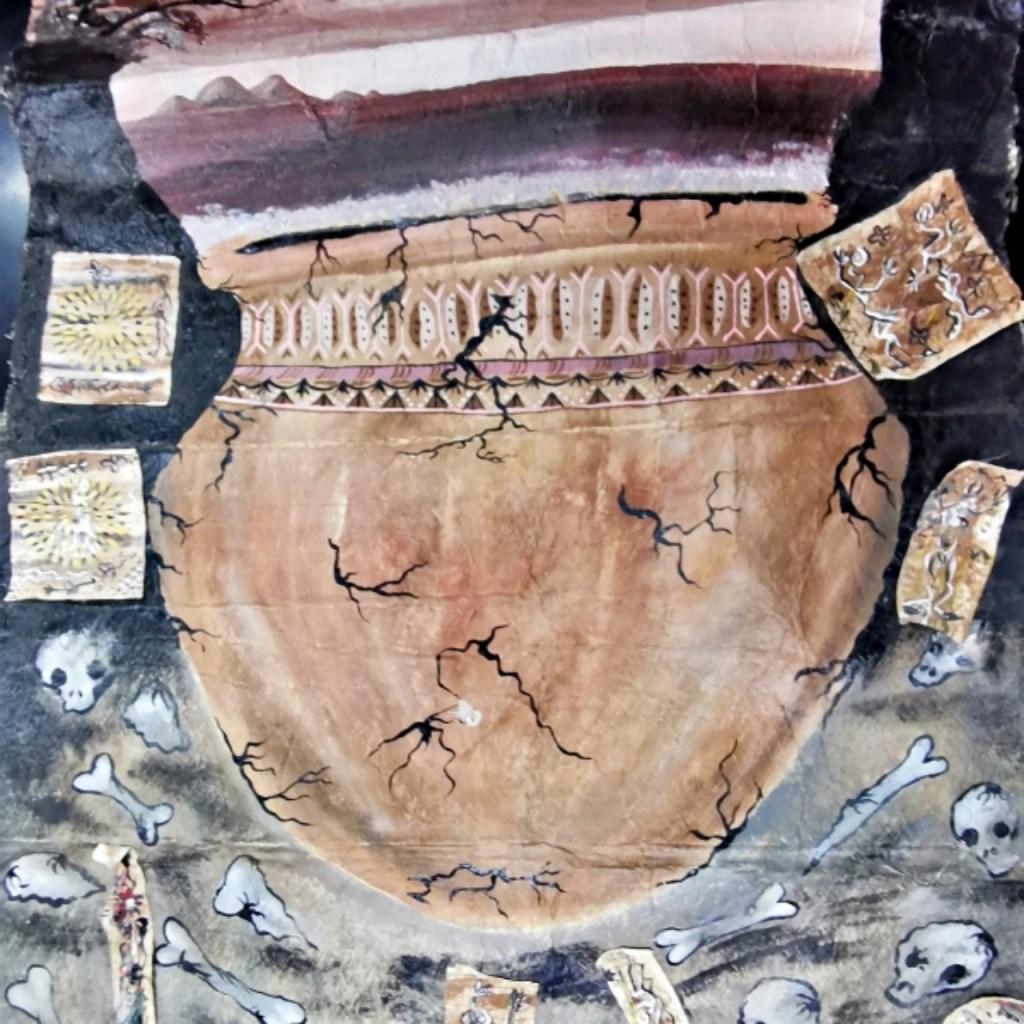
In 2004 archaeologists located the largest cemetery in the South Pacific on Efate, one of the eighty Vanuatuan islands and also home to their capital. The Teouma burial site revealed much about the people and their burial traditions. They also found astonishingly decorated pots that date back to 1300 BC. One that was mostly in tact was found with a human skull inside.
Interestingly enough the painting that we purchased in Port Vila has a pot that is eerily similar to this and we were told that is the pot where “the man was cooked” before being eaten. Since the tradition of making the Lapita pottery appears to have gone out of style about 500 years after their arrival here it seems to indicate to me that cannibalism dates back a very, very long time in this part of the world.
Yes, this country is full of a very interesting and colorful, if somewhat dark and eerie past. It’s hard to gain a true understanding of it in just a month which is all the time we have to spend here but having read and known about much of what has transpired over the years we decided we needed to give another Kastom village tour a shot.
So, after arriving in Luganville a week ago we booked a tour to the Leweton Kastom Village to see if their tour would provide any additional insight into the people of the past and as well as how they have adapted today.
We anchored in front of the Beachfront Resort as we’d been told it was cruiser friendly and it certainly is that. Stuart, the manager, has made certain to give cruisers aS warm welcome. The resort has a pool and outdoor restaurant/bar available to use and you can even use their showers is you want to pay for them.

We got our laundry done pretty cheap and they took our garbage for a small fee but given that we’ve struggled with finding a place to get rid of trash in these islands we were all too happy to pay. And a taxi ride into Luganville center runs $300 Vatu so it’s very reasonable.
Just note that if you ask in the office and they send Peter to pick you up he’s going to gouge you. He charged us $2000 Vatu to take us to town, wait twenty minutes at the grocery and return us. We could have taken two taxis and spent just $600 Vatu.
We found it’s better to walk out to the main road where taxis come by every few seconds. In fact, we’ve decided that Luganville is the taxi capital of the world. Seems every car you see has a taxi sign on it so you won’t have to worry about finding one.
Our first day in the anchorage we headed to town to do some provisioning and schedule the tour of Leweton Village. Our beer and vodka stores were depleted and, of course we could also use a fresh, French baguette or two.
The trip to town in the taxi was an adventure all on its own. Here they “officially” drive on the right side of the road. This comes from when the American soldiers were here building roads during WWII. That said, the roads are so bad and filled with potholes the size of small children that no one actually drives on the right side unless there is another car coming at them or that side just happens to be pothole free for a few meters.
In fact, they drive so willy nilly from one side to the other that at first glimpse you’d think everyone must be stoned out of their minds on world’s strongest kava that is grown here. I have found that I get quite tickled as we’re going from place to place just watching the circus like antics of it all. And yet they don’t seem to have too many accidents so it must just work for them.
I guess you do what you have to do when the roads have not been replaced since they were laid down by US troops in 1942. Seems their government would rather put dirt in the holes every once in a while rather than actually try to fix the roads properly. And, with all the rain they get here the dirt filled pots become nothing more than mud pools. It’s definitely interesting getting around here.
Tribal Dancing & Ancient Traditions
On Monday morning we were due to head up to Leweton to learn about some of the tribal people there. We were very fortunate that the rains that seem to never end stopped for a few hours allowing us the opportunity to see the village.
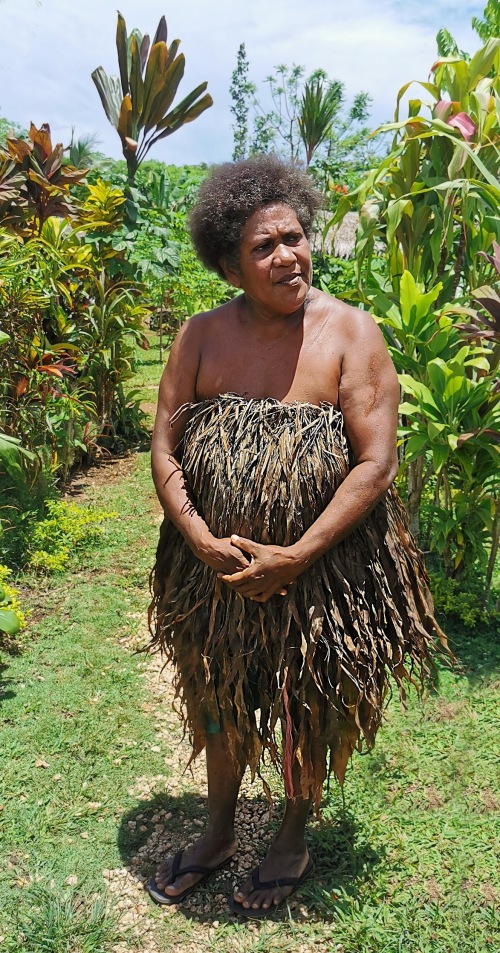
We were greeted by Celia. She is a lovely fifty year old woman who came to this village from a tiny village on the island of Merelava in the northern Banks Islands of Vanuatu. Celia was to be our guide and what a wonderful guide she turned out to be.
This village is made up of six clans (families) that came from the islands of Merelava and Gaua, also in the Banks Islands chain. They have opened up their village to tourists as a way to share their culture and ensure that their children never lose site of the ancient traditions. Well, all except that eating the man thing.
Picture the village in your mind… It’s like something straight out of National Geographic. There are well groomed dirt paths with bright green grass on either side. The jungle backdrop is lush, green and dense. Everywhere we look there are bright, tropical flowers and the smell of the natural composting of the jungle floor is pungent yet sweet.
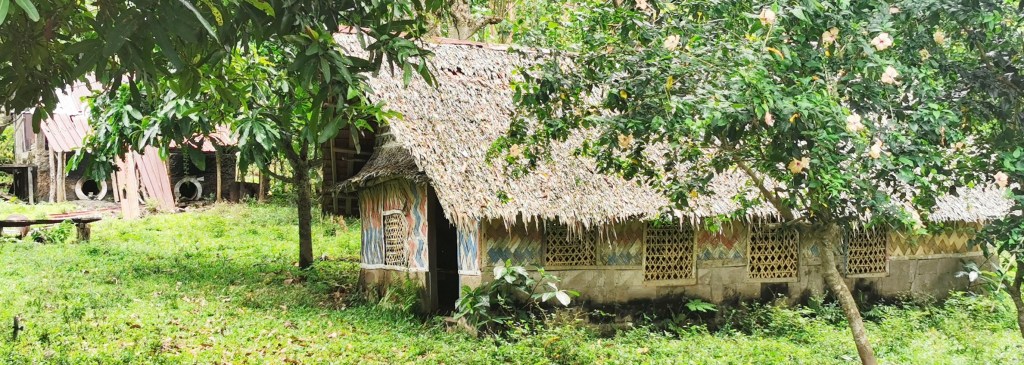
Down the paths there are thatch roofed huts and A-frame lean-tos of sorts. The roofs are made from coconut palm leaves that are woven together. The posts that hold the roof up are made of roughly hewn logs and inside each hut are benches made from bamboo sticks.
As I mentioned in a previous article, in most kastom villages the men and women do not get together except for big celebrations and to copulate. So, each village will have a women’s hut and a men’s hut.
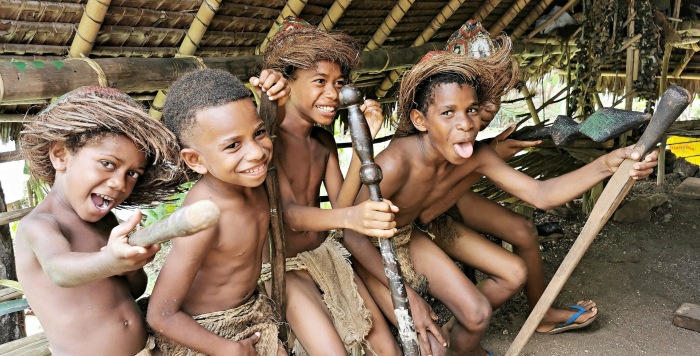
Celia takes us first to the man’s hut where we are greeted by young boys wearing nambas (penis sheaths). They have hats made from coconut shells that are painted and have fringe made to look like hair. Sitting on one of the bamboo benches holding spears they try to look fierce yet they can’t seem to help but giggle as we approach.


Inside the hut Celia explains that it is here where the men and boys drink kava together. The men tell stories and teach the boys all the things they need to know to become men. Sort of sounds an island style pub to me but who am I to say?
In the center of the hut on the floor is a large stone and on it they have several coconut shell cups filled with kava. Celia tells us we can drink the kava but because it is so strong they don’t allow it until the end of the tour because they don’t want us to get stoned and not be able to complete it.
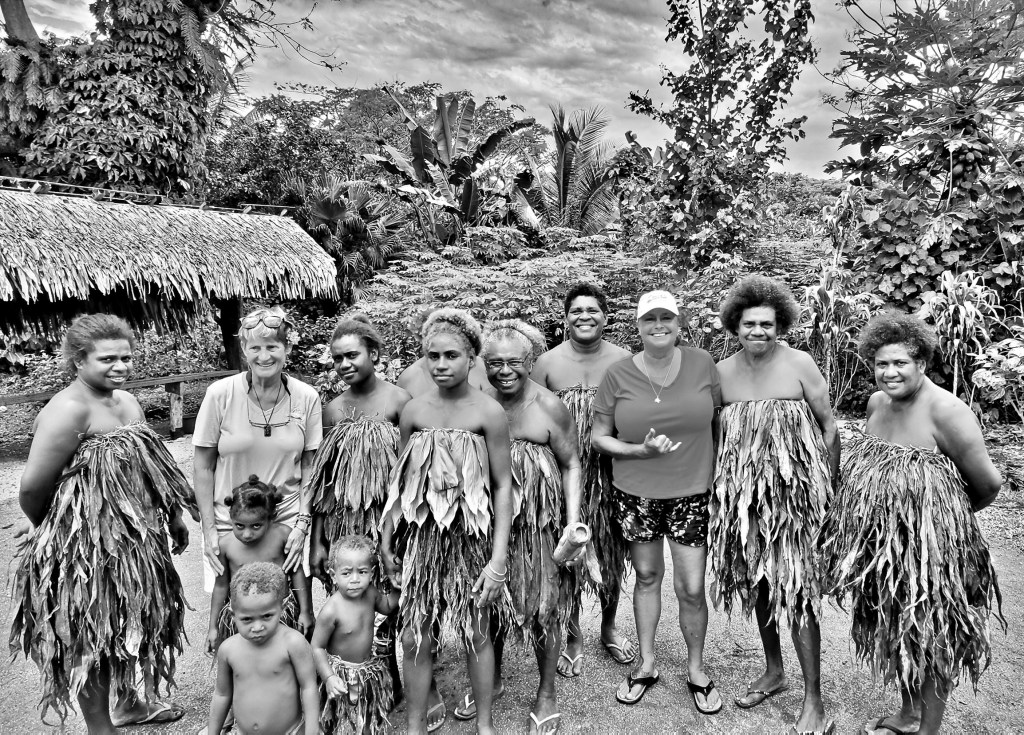
From here she takes us to the women’s hut. This is the place where all the real work gets done. There are six or seven women all dressed with palm frond tops and shorts…shorts are obviously part of the modern dress as Celia tells us that in the actual villages they only wore the palm frond skirts and no tops.

The women in the hut range in ages from their teens to a woman who is eighty-eight! They talk to us about all of the jobs the women do in the village. Aside from the typical women roles of cooking and raising the kids they also do all of the weaving of the palm fronds for the huts. And, the walls of huts that are made of woven mats are all made by the women.
They do the fishing and gathering of fruits and vegetables and well, aside from putting up a hut, hunting, starting fires and eating other humans, the men appear not to do a whole lot. One interesting tidbit is that in these traditional villages men are the only ones allowed to start a fire. If the women let the cooking fire go out in their hut they must call on a man to restart it.
I’m hearing this and thinking, “Wait…I have to do everything from birthing kids to weaving walls and hut roofs and you won’t let me start a simple fire?” I can see it now….hubby and wifey are arguing because he’s been sitting in the men’s hut doing nothing but drinking kava all day so she throws dirt on the fire to put out and hollows over to him “Enjoy your cold, uncooked cassava root butthead.”

It is certainly humbling to hear all that these women must do in their villages. And while we modern women may say that we can relate as we’ve worked and raised families you must remember that they are doing this in the most primitive environment. They don’t have any modern conveniences. Every chore is exponentially more difficult to accomplish. My hat is off to these women.
After spending a half our or so with the women we are taken to an area where the women and men will perform some traditional dances for us. First come the women. The same women we just left in the hut come stomping down the path into the open dirt staging area. They are singing and pounding their feet on the ground. It’s sort of like music but very tribal. The old lady, well, she has a set of lungs on her. Several times during their dance she let out a tribal yell that she held for close to thirty seconds. I know, I counted on my video timer.
The dance they are doing tells the story of a mother chicken and her chicks. Two of the women beat on bamboo rods with sticks using them as a sort of percussion instrument. As the dance continues it reaches a more fevered pitch. Before I know it a woman grabs my hand and has me stomping and circling the others. The stomping and singing and yelling is so primitive yet natural feeling. I find myself really getting into the whole thing.
When the women’s dance is over they leave the area so that the men can perform their dance. You see, the women are not allowed to watch the men dance. I guess it would get a little too crazy with men dancing in nambas and their junk all bouncing up and down.
Today, however, village men wear their nambas but underneath them they have on underwear so we are saved from viewing the man junk swinging about.
If the women’s dance was powerful then the men’s dance was thunderous. They wear these bean pods around their ankles that make a clicking noise. They grunt and yell and chant while dancing in a most aggressive way while brandishing brilliantly carved spears. At the end of the dance they come closer and closer and then jump at us with the spears.
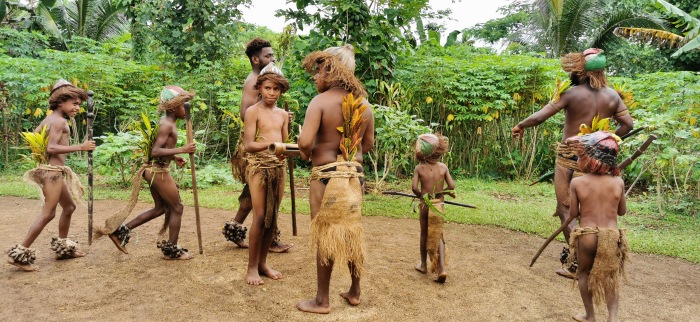
It’s a fierce moment and we see how much the young boys love to act out in this way. Again they try to look so tribal and mean but they can’t help but giggle when they scare the Kamats.
With the men’s dance complete we are taken to the pool. Yes, it’s a pool of sorts that is half filled with water. All of the women are now in the pool and Celia explains that they will play the water music. The dancing was amazing but this, this is something you really have to see to believe.
These women use the water as a percussion instrument and they actually play it. They made the sounds of waterfalls, whales, dolphin and much more. It was truly one of the most incredible things either of us have ever witnessed. In fact, this is such a cool thing that these women have been flown to Universal Studios in Florida and to other places around the globe to perform their water music.
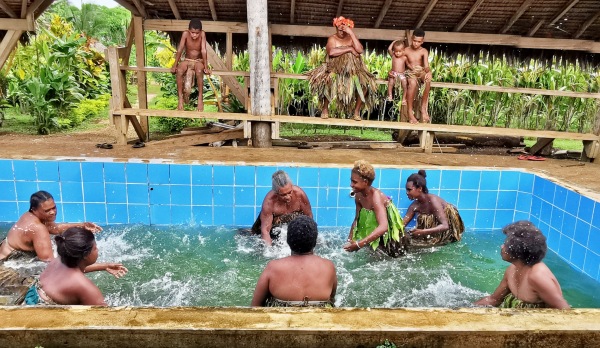
To try to explain it would be impossible except to say that it was something you have to see and hear to believe. I did take lots of video and when we are in a country with better, cheaper internet I will be uploading it because it really is something to be shared.
Once the water music was complete the boys and men joined us at the pool where they all sang a traditional farewell song to us. There wasn’t a one of them that couldn’t sing. Seems to be that way in the islands. They all have great voices.
On our way out that had us stop by the men’s hut and try the kava. We get a kick out of how they are all so cautious with having the white man drink it. They are always certain we will be stoned out of our minds. They don’t drink alcohol so they think this stuff is the bomb. We don’t want to take away their pleasure so we tell them that it is definitely strong and they all smile.
An hour and a half after our arrival it is time to say goodbye to our new friends. The things we learned about how they use the entire coconut palm, how they cook and live is fascinating and a bit humbling. It’s a tough life in these primitive villages. I know that I think it’s hard living on a sailboat sometimes but it’s nothing compared to the way these people live.
And, interestingly enough while the modern world is invading their space and they have adapted to it, there are still villagers in these islands that continue to live just the way they showed us. There are people in the mountains who still eat slugs and worms and whatever they can gather from the jungle to give them protein. They live even more primitively than what we have just seen. And, there is a slight possibility that in those very remote and unseen villages they still have a taste for the man.
Has anyone seen Bob lately???
Until next time,
Jilly







 Dazzler's Watch