Category: Captain’s Toolbag

Rebuilding Saves Money

Last cruising season while enjoying the warm tantalizing waters of Fiji, you may recall we had some electrical difficulties with our windlass motor and engine starter.  

I had saved the defective windlass motor with thoughts of possibly rebuilding it.  A few weeks ago Jilly alerted me to a cruiser advertisement of a used Lighthouse windlass motor and parts for sale in the Opua area which is about an hour north of Whangerie.  We made contact with Gary Slidell and eventually made a day trip up to Opua to have a closer look at the used motor.  

We met with Gary and I examined the motor which had been taken apart.  The magnets were still attached and in place inside the cylindrical motor housing.  The end caps and the brush assembly although covered in carbon dust all appeared to be in serviceable condition.  The armature, windings and commutator appeared to be in good condition as well.  Gary only wanted $89 USD for the unassembled, used motor.  He, in fact, sweetened the deal by offering a chain gypsy and a guarantee that if the motor didn’t work once I got it back together, he would provide a full refund.  I figured I had nothing to lose except my time.  
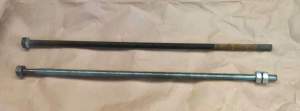
A few days later back in Whangarei, I decided to begin tackling the motor restoration.  One of the long skinny bolts that holds the case together had broken off in one of the end caps.  The first order of business was to get some new bearings, an end cap seal and a new long, skinny case bolt.  Here in Whangarei is a business called Donovans, a place where you can get or order just about anything needed to rebuild electric motors.  This is where I obtained the bearings, seals and some treaded stock and nuts that matched the tread pattern of the damaged end cap.  Next I took the end cap and treaded stock to a local machine shop to have them extract the end bearing, broken machine screw, cut the treaded stock and weld the nuts onto the rods to make new long, skinny case bolts. 

Back at Dazzler I cleaned up the brush assembly, case and other end caps.  Everything was starting to look like a clean motor that might return to life.  The armature and commutator were inspected and found to be in good order.  I did take it to the machine shop to have it turned on a lathe to clean up the surface of the commutator.

Once everything was back from the machine shop it was time to start to get it back together.  First I wanted to give it some fresh paint.  The exterior surfaces were all prepared, primed and finished with a top coat. 

The next day after letting the paint dry, I installed the new bearings and seal and began the reassembly process.  Both end cap joints were slathered with silicone sealant to help keep out water.  Everything looked proper and I didn’t have any parts left over which is always a bonus. The Kevlar coating was then replaced with the aid of a good contact cement.  Now it was time to apply a 12 volt power source and see what happens.  Jilly provided the drum roll and Bam!  It worked both forward and reverse.  Dazzler once again has a replacement windlass motor.  

There are those that might say why not just buy a new motor?  The company address for Lighthouse Manufacturing is in Riverside, California.  The cost of a new replacement motor is approximately $1,200 USD and then there is the shipping of a very heavy electric motor to New Zealand.  I hate to think what that may cost.  Obviously, if we had no other options we would have ordered a new motor. 

All in the cost of rebuilding this used motor in US dollars.

As you can see a working motor at a fraction of the cost of a new motor and it leaves money left over for the next project.  Sometimes rebuilding something can be worthwhile.  This was the first time I have ever rebuilt an electric motor.  Thank goodness for the internet and the plethora of “how to” videos and other valuable information at your finger tips.  As I have said before, “If it’s already broken or not working, You can’t hurt it any more.”  Besides I had a return refund waiting for me if it didn’t work.  LOL  Trying to fix something not working is something I believe in and have employed many times in fixing other issues on Dazzler.  The worst case scenario would be buying and shipping a new motor from the States.  The best case scenario is we saved some money and I learned a new skill of rebuilding an electric motor.  The satisfaction of a “can do” attitude….Priceless!

By the way, the old motor that had stopped working in Fiji would have required a $650 USD rewind on top of new bearings and new brushes.  This motor is identical to the replacement motor currently on the windlass.  I decided to cannibalize some of the parts and save them for a rainy day down the road.  You never know what can happen in Water World and what is useful until you need it and seashells and coconut husks won’t work.  LOL

Until the next time this old man writes another article, stay healthy my friends with fair winds, following seas. 

Cheers!

Captain Dan

Sparkle’s Dazzling New Chaps

Here we are in New Zealand Lockdown 2020 waiting for who knows what our future has in store for us.  Projects abound on Dazzler and the next project du Jour is a new set of Chaps on Sparkle.   Last week I sewed up five new fuel can covers and this week it’s a new set of dingy chaps.  Things are going swimmingly.  Because I’d made chaps before, I learned several things during that construction that I thought I’d do differently if I ever had to make chaps again.  I thought way back in 2009 that I’d never have to make another set of chaps again.  Well, here we are in New Zealand and in need of having a new set of chaps for Sparkle’s facelift. 

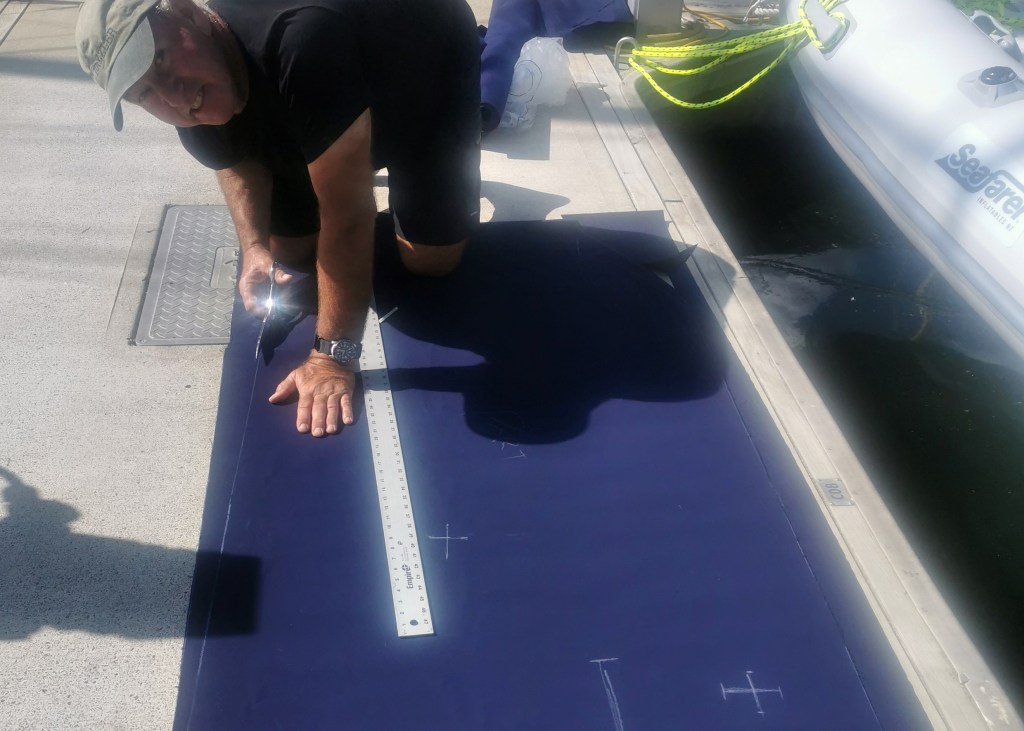
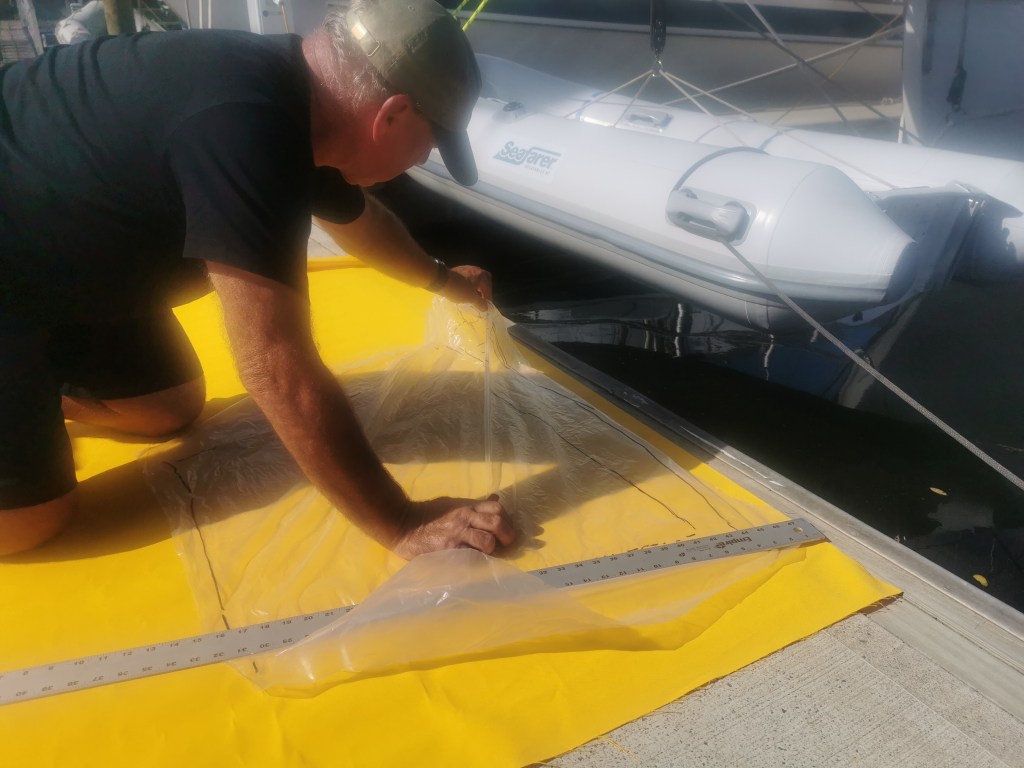
I first used some clear plastic painter’s drop cloth to make a pattern of her new tubes.  I then transferred the pattern to the new Sunbrella fabric that we had onboard from Mexico.  After the pattern was transposed to the fabric, I did the first cut of fabric.  I decided that I wanted all of the cutout openings around the handles and other equipment to be pre made before the cut out of the fabric was complete to save some time and frustration of turning a bunch of fabric two or three times through the yoke of the sewing machine.  So, I made uniform patterns for the handle cut outs from a coated fabric that has a high UV resistance.  I made two identical pieces for each opening, sewed them together and trimmed the inward edge with leather trim.  Much easier to get a good pattern and finished look with a smaller piece of fabric.  The purpose for the two identical pieces of this fabric would make it easy to sandwich the chaps fabric between them and then over stitch it to secure it in place with a more precise finish and placement of the opening trim.  And in the process make it easier to sew.  We will see what happens.  All things were working nicely so far. 

After all the openings were stitched onto the main panels, it was time to start stitching the panels together.  This is where it can get a little tricky.  I did make some alignment marks to help set it up for sewing.  I’m not sure how many trips I made back and forth from the dock to the companionway and down below where my Sailrite sewing machine was set up.  My social distancing exercise was almost done in place at Dazzler’s dock.  The old adage of measure a butt load of times and cut or sew once was in full usage.  Needless to say all went well with stitching the panels together.  

Next were the stern cones attachment to the panels.  I used Phifertex mesh fabric to allow any seawater that gets forced up under the chaps the ability to drain out with ease.  After the cones were stitched in place, I finished off the interior edge with a pre-made hem along the straight run and used leather binding to finish off the cut edges.  By the way all of those areas that had a cut edge had reinforcing fabric placed underneath and stitched in place.  This was done were sharp 90° corners existed.  This makes the corner stronger and more resistant to corner tears from stretching as the fabric gives and shrinks.  And yes, even Sunbrella fabric in my experience will have a bit of shrinkage.  So allow about an inch per side for the inevitable shrinkage factor.  

Next, I finished off the trim around the stern cones to get ready for the exterior hem to be added.  Everything was taking shape daily and all the other boaters on the dock would give their positive nods, looks and comments as they would walk by on their journey keeping two meters away from me while they headed off to do their grocery store trips or exercise tracks.  They could see the daily progress and of coarse they asked lots of questions and made comments like, “When you’re done there come on over to do ours next.”  LOL. Our neighbors on the sailing vessel Greyhound, may have decided to get new tubes made for their tender now before they make their own dingy chaps.  Marie did say she was jealous because she hadn’t purchased any fabric before the great lockdown of 2020.  

The next step was to make the exterior hem which was about 260 inches long.  I first joined several sections of six inch wide fabric together to make the needed length.  Then I started folding and stitching the long runs to accommodate the needed hem for the exterior of the chaps.  This hem will also house a 3/16” Dacron cord to act as a drawstring to cinch the chaps just below the rub rail of the dingy sides.  With the 250 thousand foot hem, LOL, and Dacron cord ready, I grabbed a sandwich, a beer, turned on some sewing music and started folding the cord into the hem and stitching it onto the exterior cut edge of Sparkle’s new sexy chaps.  A day and a half later, my sandwich was gone, I was on my third beer and Jilly was covered in what looked like a blue and yellow heap of fabric as she was sitting on the opposite side of the table from me.  I couldn’t immediately see her so I yelled out, “Marco?”  Her response, “Polo!”  There she is!  And yes, she did a great job supervising while recuperating from her torn muscle injury.

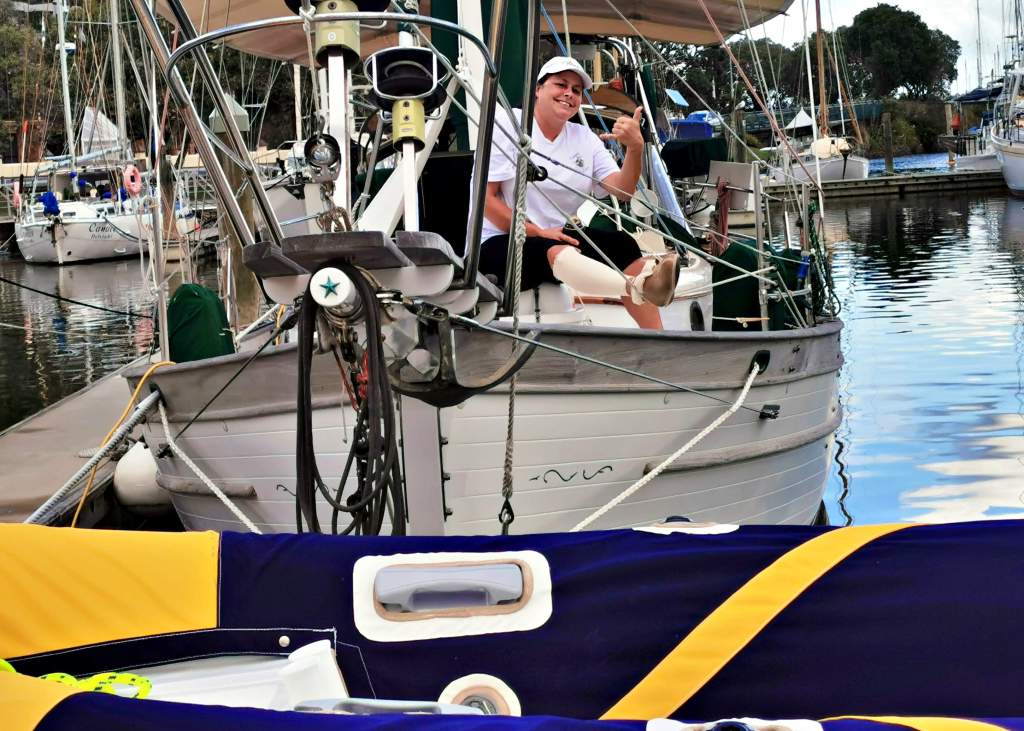
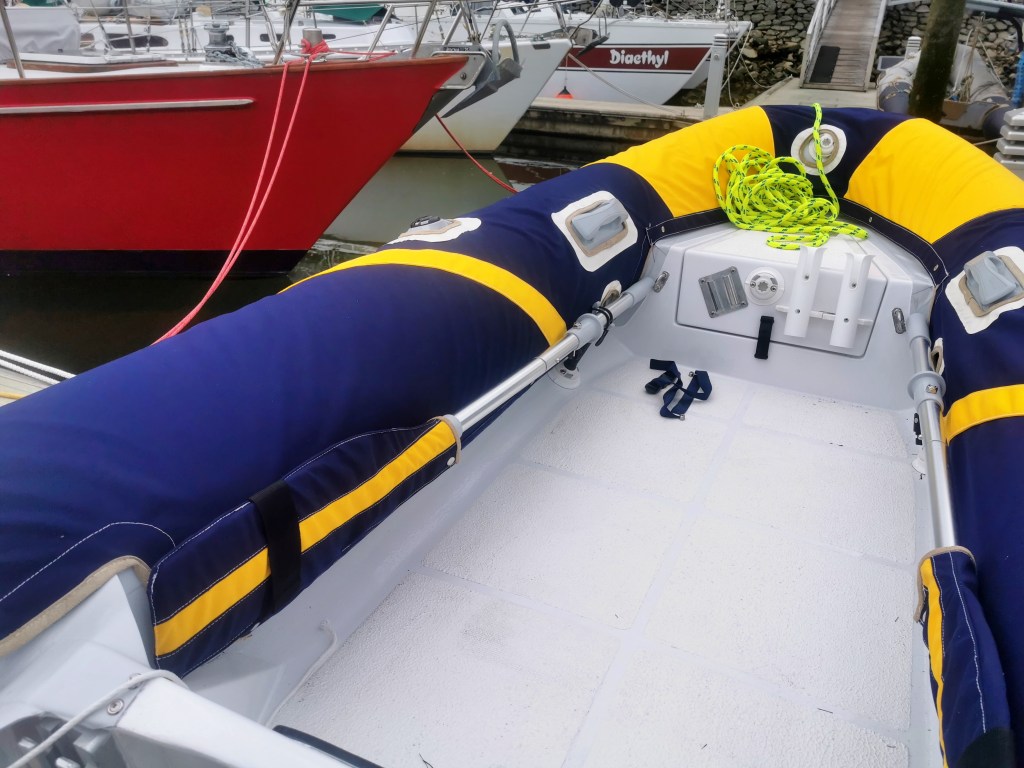
Drum roll please…  It was time to go out and test fit the chaps onto Sparkle’s new tubes.  Tada, She fits!  A little tug here, pull there, stretch the draw cord and tied it off to the transom cleats on the stern.  She is finished!  The only thing left to do was to attach a yellow racing stripe on each side for easier identification during full moon dingy racing and add the Snads and snap fasteners to the inside of the tubes to hold the inside fabric in place.  Snads are a product manufactured by YKK and have a very robust 3M adhesive backing that easily sticks to the inflatable tubes without drilling any holes.   

Cracked open a celebratory beer, took some hero photos and got ready for the next project.

Until the next project, keep two meters away from each other, enjoy your lockdown confinement and stay safe.

Cheers!

Captain Dan

P.S. As an afterthought I decided to add a couple of pockets for the ores to sit in. Turned out quite nice I think.