Category: October 2022

One Dazzling Passage

One Dazzling Passage
Published 2022-10-28

The time has come to leave Vanuatu behind and make our way toward Australia for the coming cyclone season. Making passage in the South Pacific Convergence Zone presents its own type of challenges. Click below to find out more.

This year we have been making up for lost time. It just goes to show you that even the Vid can’t keep us down forever. New Zealand to Fiji, Fiji to Vanuatu and now Vanuatu to Australia. We’re making one dazzling passage yet again.

The time was right as we have come to the end of another cruising season in the South Pacific. It is time to head to a safe area to hole up and avoid tropical cyclones. We are off to a hurricane safe dry storage on the east coast of Australia to put Dazzler on the hard for a few months. We joined one of the popular cruising rallies known as the Go West Rally. The fee to join the rally covers almost all of the cost for the Australian check-in process and helps facilitate contact with the Australian Government Officials for clearance into the country.

Part of those included costs is for a timber inspection. We’ll wait to see how that goes as Dazzler’s interior and exterior has the lion’s share of a teak forest. Additionally, there are marine supplies and services discounts available to participants as well so it’s a very good deal for us.

Time to Say Goodbye to Vanuatu

Every day for the month we’ve been guests in Vanuatu we have experienced rain. Sometimes it seamed like the bottom of a lake in the sky had opened up and dropped buckets of liquid sunshine on top of us. Other times it just kind of misted on you like an incessant and irritating nag. The interesting thing is that the mist dries so quickly that you don’t need to wear a rain shell.

We made all of our Customs and Immigration clearance preparations on Friday morning. In Vanuatu they give you 24 hours to clear out of country. Other countries we’ve visited will literally watch you untie and leave the dock to verify your departure. Saturday morning we were busy onboard Dazzler finishing up last minute details while being treated to more rain. Luckily I completed everything on deck and was ready to go. I had enough forethought to remove the mainsail cover Friday afternoon so we wouldn’t have to store wet Sunbrella down below.

Hoisting anchor in the rain is like cutting grass in the rain. Not much fun, but sometimes the task is not always about fun. We chose to head out of the Segund Channel past the Wambu River. Apparently so much rain had been dumped on Santo Island during the last day that the rich yellow brown color of the soil was so thick in the channel it looked like a coconut bowl full of Kava. I nicknamed it the Kava River.

We cleared the channel and entered the Coral Sea west of Vanuatu. We were on the leeward side of the islands and the Trade-winds had not filled in yet requiring us to motor just a bit further. Motoring, hummm. This passage is just short of 1000 nautical miles to our destination. The weather is favorable for our departure, however we expect to encounter several very light wind days. Including a few days with wind possibly on the nose. Dogs sticking their heads out a car being driven down the street may like wind on the nose, but don’t most sailors prefer winds on the beam or quarter with following seas? We certainly do.

I make this point to mention that we will have to watch our fuel consumption as we may have to motor for several days during this trip. In fact, we bought two extra 30 liter plastic jugs in Luganville and filled them with diesel to increase motoring range a bit.

About six hours into our trip we finally had the silence of the motor and we were sailing again. The wind was predicted to be on our port quarter, but in reality it was on our stern. Night was starting to set in and the clouds looked like more rain was in our immediate future.

The seas were seven to eight seconds with 1-2 meters swells and the wind was 17-20 knots on our stern. We deployed a single reefed main and the staysail and sailed at an angle off our charted course line to keep the sails filled. The first two nights brought several squalls that dumped buckets of sideways rain complete with gusts of up to 25 knots.

There was one thing I did not look at in preparing our voyage and that was the local ocean currents. We fought a 1-2 knot ocean head current until early Sunday morning. Sunday evening had come and the winds had seriously diminished to the point of firing up the Iron Horse or as our dear friends of SV Suan would call it, “Yanmar San.”

Trying to resist the urge of pushing the throttle forward while running at economy mode (1800-2100 RPMs) and only going 3.5-4 knots an hour was painful. But conserve we must and the result was a long slow night. We had dropped the sails to keep them from flogging and prevent any undo wear and tear on our equipment. This action resulted in our rolling side to side through the sea making someone an unhappy sleep camper. Apparently being rolled from side to side while in the bunk just really isn’t that comfortable.

Sunday night about 2200 hours I went down into the dark cabin to put my iPad on the charger. I thought Jilly was asleep on the settee on the starboard side where she was earlier. I didn’t turn on any lights because I didn’t want to wake her. What a nice man for thinking of her. When I put my hand down onto what I thought was a pillow around our table, I immediately realized that it wasn’t a pillow. Apparently, Jilly thought that the Kraken had come for her which resulted in screaming, mass hysteria, startled men, purple apes climbing the mast and even caused the oceanic white tip shark following along Dazzler’s wake to take notice and make a rapid about face.

After a few moments we all calmed down, caught our breath and I went back up to the cockpit to finish the last hour of my watch. Jilly was going to try to get back to sleep. About 10 minutes later, it was agreed that she would come on watch an hour earlier because there was no way she was going to get back to sleep after her near death experience with her husband mistaken for the Kraken armed with an iPad in need of a charge.

Enter the beginning of day three

After trying to sleep on the Tilt-a-Whirl ride I got up at 0300 hours for my watch. The sea state had calmed a bit more and the winds were still MIA (Missing in Action). After the sun started illuminating the cloud filled sky we could now see the squalls that were going to hit us instead of just watching their approach on the radar screen. The unhappy crew has made their complaint known and submitted it in triplicate to the captain, “I’m tired of all this rain. When are we going to have some sunshine?”

I’m sorry, but my crystal ball has been broken for years. I just shake it up real good turn it upside down and try to see the message on the bottom through that purple liquid stuff. The message reads, “Sorry, not enough data input.” Needless to say this wasn’t the answer the grumbling crew was looking for. As a side note Grape Ape sides with whoever is opening the cookie jar at the time. So, there is a fifty fifty chance as to which side he takes.

About two hours later, princess Jilly woke to blue skies, sunshine and 12 knots of wind pulling Dazzler gently along at 5-6 knots without the noise of Yanmar San. Someone was happy now. Grape Ape and I were glad to see someone happier. It’s amazing how blue skies and sunshine can help get you get out of a funk. It even has a built in memory blocker to help you forget what you were unhappy about just hours earlier.

Actually brochure sailing makes everybody happy. Long rolling swells about eight seconds apart, steady trade-winds from the south by southwest, a full set of sails spread out catching the wind, sunny skies, fluffy white clouds dotting the blue sky and the glacier blue color of the ocean. Yes in deed this is brochure sailing.

After another night of mixed weather, sail changes and motor starts and stops we made it to day four. It appears that this area of the South Pacific is heavily influenced by weather patterns, ocean currents and sea temperatures. Apparently this year’s upcoming cyclone season has the potential to be active earlier than normal. The season starts November first. All the more reason to keep moving through the area as quickly and as possible.

Today we made our first fuel transfer into our main tank. We decided to empty the two new 30 liter jugs first. We have a few different ways of siphoning fuel from the plastic jugs without making a mess of trying to pour fuel into a 1.5” hole in Dazzler’s deck to her fuel tank. My preferred methods is the use of a Jiggler valve. Named after the motion you use to start the siphon action flowing. The tip is a metal cylinder that has a clear marble like bead about a half inch in diameter mounted on the inside. The tip is fit into a half inch clear hose that is long enough to reach both the bottom of the jug and slip about a foot and a half down the fuel deck fitting.

Tied to a marina dock makes this fuel transfer relatively easy. Out on the open ocean you need some calm conditions and fair seas to avoid any water contamination getting into the main tank during the transfer. The first jug went smoothly. Once it was emptied I moved the jiggler over to the next tank. I noticed that it was taking considerably longer to siphon. When I looked down into the jug I could see something cloudy near the end of the valve. As I pulled the jiggler out to the jug I could see a pice of clear plastic stuck in the end of the valve. I didn’t know what to think. As I looked down into the tank I could see more silhouettes of cloudy objects. My first thought was I hope none of these pieces of plastic got past the marble. My second thought was how can I get the plastic out of the fuel in the jug without having to try to pour the remaining 20 liters of fuel into the deck fill hole without making a mess.

Enter the grabber specialty tool and Jilly’s favorite tool on Dazzler. It is about 30” long, has a thumb button on one end and four pronged thin metal fingers on the other end that open up to about an inch when you push the spring loaded thumb button. It works great for pulling tools out of the bilge and/or it can entertain Jilly for hours playing Go Go Gadget Claw.

I used the grabber and was able to get enough of the plastic out that the jiggler valve extracted all but about two liters. The only reason I stopped it at that point was I could see more plastic in the bottom. Armed with a large funnel, Jilly’s help and a paper towel for a filter, I poured the remaining fuel through my makeshift filter system and extracted the remaining pieces of plastic from the fuel. Basically, we bought these jugs off a shelf in a hardware store in Luganville, went to the fuel station to fill them and then secured them on Dazzler.

Apparently, someone had placed a plastic bag and some plastic shards of a cup or something similar into the jug while it sat on the shelf. I didn’t even think to look into the jugs before they were filled at the fuel station. I opened the tanks to be filled and watched the fuel attendant dispense thirty liters of fuel into each jug. I guess I’ll have to be more diligent in the future.

Light Winds Continue

The winds were light and we flew the spinnaker for about four hours before the atmosphere became still and very warm forcing us to douse the spinnaker and fire up the motor once again. This lasted for several hours before the winds built up again and allowed us to stop the engine and hoist sails again.

Some passages have predictable winds that are steady and for the most part from one general direction. That is not this passage. This is not the Poppeil Set It And Forget It passage. Lots of sail changes, course changes and slow speeds. Thank goodness we have about a two knot tail current to help push us along. I told Jilly that if our fuel gets too low we can just drift along with the two knot current and get to Australia by December. LOL

Another night of squalls, light winds and a lightening show that passed about ten miles behind us. Not an easy feeling when your Aluminum mast projects about 55’ above the surface of the water. It kind of screams out, “Pick me, pick me, I’m right here.”

All things considered, I’d rather be right here trying to figure it out instead of stuck in six or seven lanes of bumper to bumper stop and go traffic on I405 in Los Angeles. That will be next month.

Stay tuned for the next installment from Captain Dan and crew on Dazzler making passage in the Coral Sea. Grape Ape! Get your finger out of there. We don’t know where it’s been. Kids!

Cheers!

Captain Dan
Tribal Dancing & Ancient Traditions

Vanuatu, originally named New Hebrides, is believed to have been first inhabited by people over 3300 years ago. Archaeological evidence has shown that the Lapita people were the first human settlers in the South Pacific. These settlers arrived from Taiwan migrating through Papau New Guinea down to Vanuatu and when they did they brought with them tribal customs, Kastom dancing and many ancient traditions.

Copyright Musée du quai Branly

In 2004 archaeologists located the largest cemetery in the South Pacific on Efate, one of the eighty Vanuatuan islands and also home to their capital. The Teouma burial site revealed much about the people and their burial traditions. They also found astonishingly decorated pots that date back to 1300 BC. One that was mostly in tact was found with a human skull inside. 

Interestingly enough the painting that we purchased in Port Vila has a pot that is eerily similar to this and we were told that is the pot where “the man was cooked” before being eaten. Since the tradition of making the Lapita pottery appears to have gone out of style about 500 years after their arrival here it seems to indicate to me that cannibalism dates back a very, very long time in this part of the world.

Yes, this country is full of a very interesting and colorful, if somewhat dark and eerie past. It’s hard to gain a true understanding of it in just a month which is all the time we have to spend here but having read and known about much of what has transpired over the years we decided we needed to give another Kastom village tour a shot.

So, after arriving in Luganville a week ago we booked a tour to the Leweton Kastom Village to see if their tour would provide any additional insight into the people of the past and as well as how they have adapted today.

We anchored in front of the Beachfront Resort as we’d been told it was cruiser friendly and it certainly is that. Stuart, the manager, has made certain to give cruisers aS warm welcome. The resort has a pool and outdoor restaurant/bar available to use and you can even use their showers is you want to pay for them. 

View from the restaurant at Beachfront Resort

We got our laundry done pretty cheap and they took our garbage for a small fee but given that we’ve struggled with finding a place to get rid of trash in these islands we were all too happy to pay.  And a taxi ride into Luganville center runs $300 Vatu so it’s very reasonable. 

Just note that if you ask in the office and they send Peter to pick you up he’s going to gouge you. He charged us $2000 Vatu to take us to town, wait twenty minutes at the grocery and return us. We could have taken two taxis and spent just $600 Vatu. 

We found it’s better to walk out to the main road where taxis come by every few seconds. In fact, we’ve decided that Luganville is the taxi capital of the world. Seems every car you see has a taxi sign on it so you won’t have to worry about finding one.

Our first day in the anchorage we headed to town to do some provisioning and schedule the tour of Leweton Village. Our beer and vodka stores were depleted and, of course we could also use a fresh, French baguette or two.

The trip to town in the taxi was an adventure all on its own. Here they “officially” drive on the right side of the road. This comes from when the American soldiers were here building roads during WWII. That said, the roads are so bad and filled with potholes the size of small children that no one actually drives on the right side unless there is another car coming at them or that side just happens to be pothole free for a few meters. 

In fact, they drive so willy nilly from one side to the other that at first glimpse you’d think everyone must be stoned out of their minds on world’s strongest kava that is grown here. I have found that I get quite tickled as we’re going from place to place just watching the circus like antics of it all. And yet they don’t seem to have too many accidents so it must just work for them.

I guess you do what you have to do when the roads have not been replaced since they were laid down by US troops in 1942. Seems their government would rather put dirt in the holes every once in a while rather than actually try to fix the roads properly. And, with all the rain they get here the dirt filled pots become nothing more than mud pools. It’s definitely interesting getting around here.

Tribal Dancing & Ancient Traditions

On Monday morning we were due to head up to Leweton to learn about some of the tribal people there. We were very fortunate that the rains that seem to never end stopped for a few hours allowing us the opportunity to see the village.

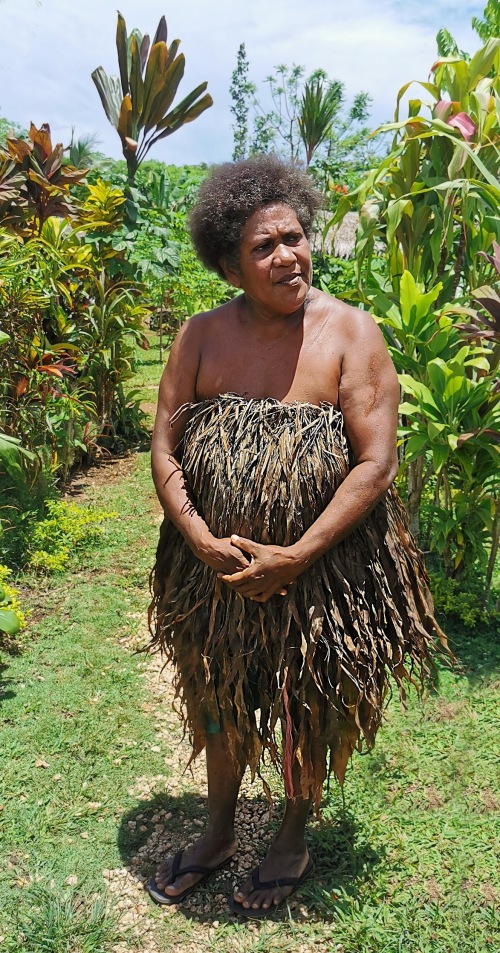
Ceila, our guide at Leweton Village

We were greeted by Celia. She is a lovely fifty year old woman who came to this village from a tiny village on the island of Merelava in the northern Banks Islands of Vanuatu. Celia was to be our guide and what a wonderful guide she turned out to be. 

This village is made up of six clans (families) that came from the islands of Merelava and Gaua, also in the Banks Islands chain. They have opened up their village to tourists as a way to share their culture and ensure that their children never lose site of the ancient traditions. Well, all except that eating the man thing. 

Picture the village in your mind… It’s like something straight out of National Geographic. There are well groomed dirt paths with bright green grass on either side. The jungle backdrop is lush, green and dense. Everywhere we look there are bright, tropical flowers and the smell of the natural composting of the jungle floor is pungent yet sweet. 

Down the paths there are thatch roofed huts and A-frame lean-tos of sorts. The roofs are made from coconut palm leaves that are woven together. The posts that hold the roof up are made of roughly hewn logs and inside each hut are benches made from bamboo sticks. 

As I mentioned in a previous article, in most kastom villages the men and women do not get together except for big celebrations and to copulate. So, each village will have a women’s hut and a men’s hut. 

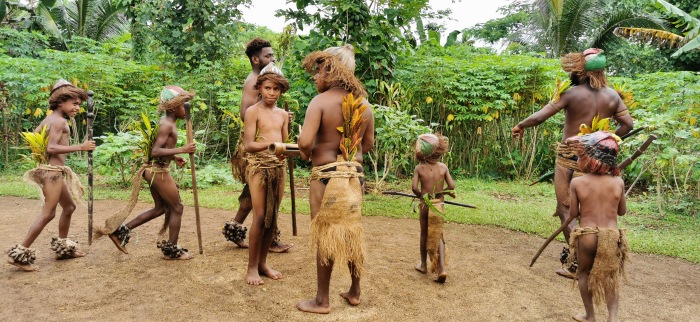
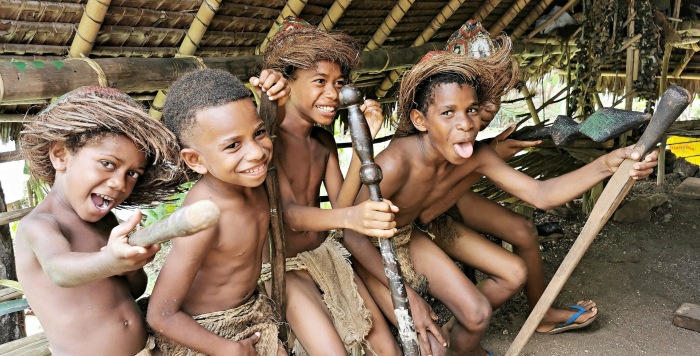
Celia takes us first to the man’s hut where we are greeted by young boys wearing nambas (penis sheaths). They have hats made from coconut shells that are painted and have fringe made to look like hair. Sitting on one of the bamboo benches holding spears they try to look fierce yet they can’t seem to help but giggle as we approach. 

Inside the hut Celia explains that it is here where the men and boys drink kava together. The men tell stories and teach the boys all the things they need to know to become men. Sort of sounds an island style pub to me but who am I to say?

In the center of the hut on the floor is a large stone and on it they have several coconut shell cups filled with kava. Celia tells us we can drink the kava but because it is so strong they don’t allow it until the end of the tour because they don’t want us to get stoned and not be able to complete it.

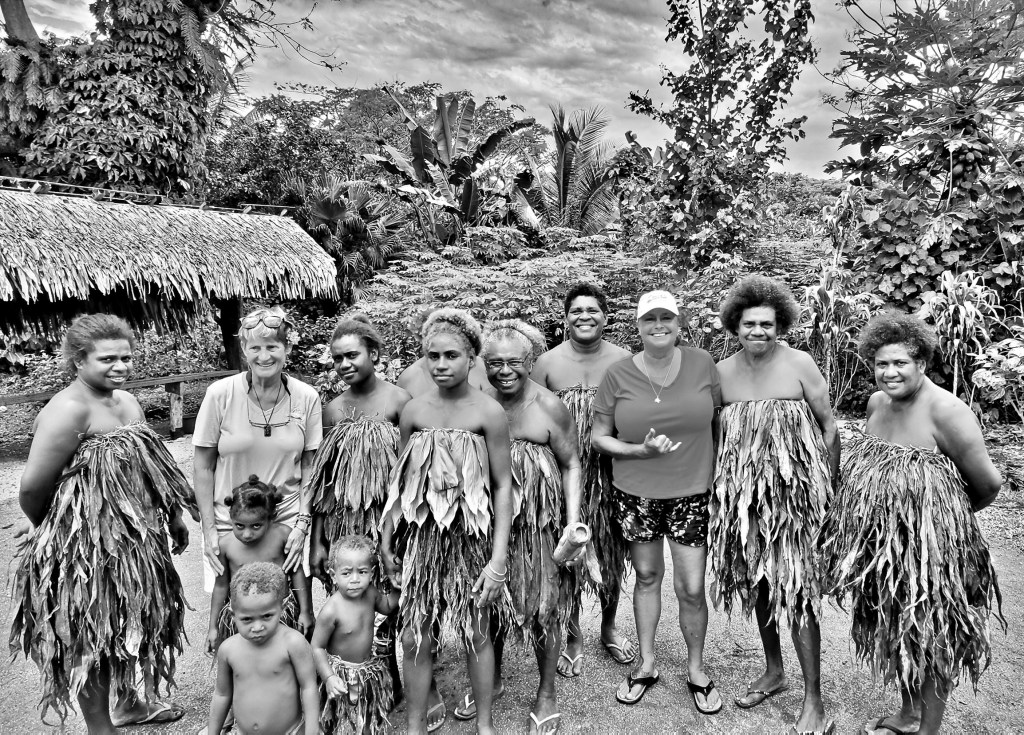
From here she takes us to the women’s hut. This is the place where all the real work gets done. There are six or seven women all dressed with palm frond tops and shorts…shorts are obviously part of the modern dress as Celia tells us that in the actual villages they only wore the palm frond skirts and no tops. 

The boys showing us how they make fire in the women’s hut.

The women in the hut range in ages from their teens to a woman who is eighty-eight! They talk to us about all of the jobs the women do in the village. Aside from the typical women roles of cooking and raising the kids they also do all of the weaving of the palm fronds for the huts. And, the walls of huts that are made of woven mats are all made by the women. 

They do the fishing and gathering of fruits and vegetables and well, aside from putting up a hut, hunting, starting fires and eating other humans, the men appear not to do a whole lot. One interesting tidbit is that in these traditional villages men are the only ones allowed to start a fire. If the women let the cooking fire go out in their hut they must call on a man to restart it. 

I’m hearing this and thinking, “Wait…I have to do everything from birthing kids to weaving walls and hut roofs and you won’t let me start a simple fire?” I can see it now….hubby and wifey are arguing because he’s been sitting in the men’s hut doing nothing but drinking kava all day so she throws dirt on the fire to put out and hollows over to him “Enjoy your cold, uncooked cassava root butthead.”

It is certainly humbling to hear all that these women must do in their villages. And while we modern women may say that we can relate as we’ve worked and raised families you must remember that they are doing this in the most primitive environment. They don’t have any modern conveniences. Every chore is exponentially more difficult to accomplish. My hat is off to these women.

After spending a half our or so with the women we are taken to an area where the women and men will perform some traditional dances for us. First come the women. The same women we just left in the hut come stomping down the path into the open dirt staging area. They are singing and pounding their feet on the ground. It’s sort of like music but very tribal. The old lady, well, she has a set of lungs on her. Several times during their dance she let out a tribal yell that she held for close to thirty seconds. I know, I counted on my video timer. 

The dance they are doing tells the story of a mother chicken and her chicks. Two of the women beat on bamboo rods with sticks using them as a sort of percussion instrument. As the dance continues it reaches a more fevered pitch. Before I know it a woman grabs my hand and has me stomping and circling the others. The stomping and singing and yelling is so primitive yet natural feeling. I find myself really getting into the whole thing.

When the women’s dance is over they leave the area so that the men can perform their dance. You see, the women are not allowed to watch the men dance. I guess it would get a little too crazy with men dancing in nambas and their junk all bouncing up and down. 

Today, however, village men wear their nambas but underneath them they have on underwear so we are saved from viewing the man junk swinging about. 

If the women’s dance was powerful then the men’s dance was thunderous. They wear these bean pods around their ankles that make a clicking noise. They grunt and yell and chant while dancing in a most aggressive way while brandishing brilliantly carved spears. At the end of the dance they come closer and closer and then jump at us with the spears.

Leweton

It’s a fierce moment and we see how much the young boys love to act out in this way. Again they try to look so tribal and mean but they can’t help but giggle when they scare the Kamats. 

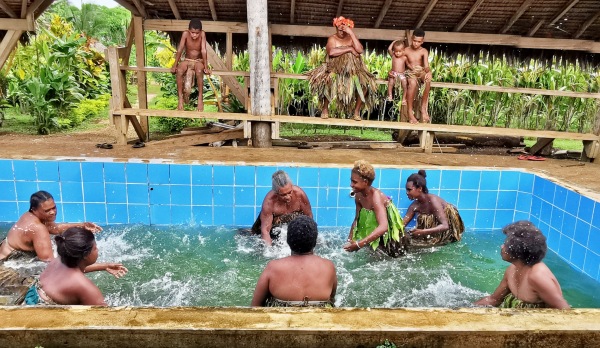
With the men’s dance complete we are taken to the pool. Yes, it’s a pool of sorts that is half filled with water. All of the women are now in the pool and Celia explains that they will play the water music. The dancing was amazing but this, this is something you really have to see to believe. 

These women use the water as a percussion instrument and they actually play it. They made the sounds of waterfalls, whales, dolphin and much more. It was truly one of the most incredible things either of us have ever witnessed. In fact, this is such a cool thing that these women have been flown to Universal Studios in Florida and to other places around the globe to perform their water music. 

To try to explain it would be impossible except to say that it was something you have to see and hear to believe. I did take lots of video and when we are in a country with better, cheaper internet I will be uploading it because it really is something to be shared.

Once the water music was complete the boys and men joined us at the pool where they all sang a traditional farewell song to us. There wasn’t a one of them that couldn’t sing. Seems to be that way in the islands. They all have great voices.

On our way out that had us stop by the men’s hut and try the kava. We get a kick out of how they are all so cautious with having the white man drink it. They are always certain we will be stoned out of our minds. They don’t drink alcohol so they think this stuff is the bomb. We don’t want to take away their pleasure so we tell them that it is definitely strong and they all smile.

An hour and a half after our arrival it is time to say goodbye to our new friends. The things we learned about how they use the entire coconut palm, how they cook and live is fascinating and a bit humbling. It’s a tough life in these primitive villages. I know that I think it’s hard living on a sailboat sometimes but it’s nothing compared to the way these people live. 

And, interestingly enough while the modern world is invading their space and they have adapted to it, there are still villagers in these islands that continue to live just the way they showed us. There are people in the mountains who still eat slugs and worms and whatever they can gather from the jungle to give them protein. They live even more primitively than what we have just seen. And, there is a slight possibility that in those very remote and unseen villages they still have a taste for the man.

Has anyone seen Bob lately???

Until next time,

Jilly

READ MORE ABOUT OUR ADVENTURES IN VANUATU…CLICK HERE