
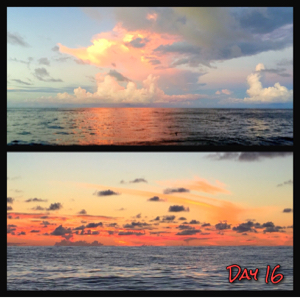
4.11.18@ 1700 Zulu Day #16 Latitude: 04°40 N Longitude: 128°43 W Covered Distance Last 24 Hours: 132 NM Distance to the Marquesas: 1054 NM Distance from Punta de Mita, Mexico: 1894 Weather: 30% Cloud Cover Winds: NE 13 Knots Sea State: NE 3’ Sea Temp: 98.2° Air Temp: 84.3° Course: 192°T Speed: 5.5 Knots Barometer: 1014° Crew’s Mood: Loving sailing through the ITCZ with NO MOTOR!
All that’s been happening with SV Aftermath has had me thinking about how people asked me over and over if I was afraid to take this journey. Hmmm. I had to really sit and ponder this a while. Why? Well, fear is clearly different for everyone. Some people are afraid to step outside of their own homes while others hardly fear anything at all. Me, I guess I fall somewhere in the upper middle. I’m not scared of everything but I do have a healthy respect for many things. And honestly, in my humble opinion, I believe anyone who approaches something like this without a certain amount of fear is crazy. After all, Mother Nature and King Neptune can be your best friends yet both can turn on you like a snake in a matter of seconds. So is my respect for the dangers that surround us a form of fear? Maybe. But, it obviously isn’t something that kept me from embarking on the journey. After all, I could just as easily meet my demise in a parking lot in Florida during terrorist, I mean tourist season. So, really, what’s more scary?
Out here we take nothing for granted. Why do you think we don’t drink alcohol underway? What if one of the Gods gets their bustle in a ruffle? We need to have our brains firing on all cylinders to handle whatever they decide to throw at us. Yes, we take this very seriously.
Here’s a great example. We were dousing the spinnaker and it was pretty calm. The only reason I am on deck is to let out the halyard while Dan pulls down the shoot. Did I really need to put on my life jacket and clip into the jack line? Probably not. I’m sure I would have been fine but what if…I mean what if a rogue swell came out of a different direction and knocked me off balance? That’s all it would take to possibly send me overboard without any flotation device whatsoever. Now I’ve put my life in serious danger and for what? To save a minute or two and the minute hassle of clipping and moving my tether as I move up the deck. No. I assessed that it was not worth it so I went below and got my safety gear. Does that make me afraid or does it simply mean I’m using good judgment? I believe it’s the latter.
When weather gets a bit nautical and all hell is breaking loose like it did during the chubasco in La Gringa last summer, was I scared? No, not really. Was it stressful? Oh heck yeah! But the fact is there wasn’t really time to be afraid. There were orders being given and I had to react with strict precision. Any deviation from that could have resulted in the loss of our beloved Dazzler and even possibly our lives. By the time it even dawned on me that I should have been afraid, the danger had past and we were safely anchored down in Bahía de Los Angeles.
Because of Dan’s Highway Patrol background we constantly discuss “what if” scenarios. What if someone falls overboard? What if we have to abandon ship? What if someone gets hurt? What if? What if? What if? Because, when the bad stuff happens your mind won’t function normally so you have to have practiced what you would do in an emergency. This way your mind goes right to that training and you react quickly instead of hesitating which could lead to disaster. Yes, we’ve prepared and practiced everything. We’ve even taken CPR and first aide classes where we learned how to suture on a hog leg. Really…I’m serious!
We also practice something out here that we call situational awareness. It simply means that you need to constantly assess the dangers around you. Are you standing in a stack of lines that could pull you overboard? When walking on deck, are you on the high side or low side of the boat? If you are on the low side you risk falling out of the boat whereas on the high side you would fall into the boat. Are you watching every step to be sure something didn’t fall on deck that you could slip or cut yourself on? Is there a strange part lying on deck that doesn’t belong there? If so, you need to find out where it came from. It could be a really important part off the rigging. Yes, these are all potentially dangerous things that one could be afraid of but by employing situational awareness you limit the possibility of accident or injury.
When I look at the situation on SV Aftermath I can’t help but think they would have benefited from some of the practices we employ each day. Situational awareness would have made them look at everything needed to keep them afloat and alive. They wouldn’t just today have realized they are about to face a water shortage because they would have assessed that in the beginning of their crisis. When Dan and I see an issue, we don’t just micro focus on that one thing. We look at the big picture to see how that one thing can affect everything around it. In their case it appears, at least from our viewpoint, that the captain is micro focused on the repairs and isn’t seeing what else needs to be addressed which honestly, could lead to disaster. Maybe that’s because he isn’t prepared or maybe it’s because fatigue has set in and his mind is not functioning at peak performance. Either way, consistently practicing “what if” scenarios could have helped him to make better, wiser decisions as to the safety of himself and his crew. Better planning and looking at the big picture could certainly have helped as well.
So you see, it’s hard to say whether or not I was or am afraid as that all depends on your definition of fear. For me, I don’t think fear has played any big role in how I feel out here because of the fact that we have prepared for this journey to the nth degree and we practice safety each and every moment on board. And, as a matter of fact, the longer we are here, the less fear plays any part at all in how I feel. You see, once you are here and you see and face whatever fears you had, they diminish in size exponentially.
Would I recommend this type of adventure to everyone? No! It takes a certain kind of person to do this, stay safe doing it and to enjoy the ups and downs of the trip. Not everyone can handle the stressful moments and many would simply be too afraid to try or would freeze up in the times of crisis. As for me, my body is sore, I’m tired and I’m looking forward to a nice long walk on a white sand beach with a fruity cocktail. Oh, and I can’t wait to go out to dinner somewhere and have someone serve me dinner on a stable surface where I don’t have to hold onto my plate for fear of it being launched into next week. But you know what? I’m having the time of my life; I wouldn’t change a thing and fear is nowhere in sight!
Until next time…
Jilly
P.S. Having the best, most prepared Captain in the fleet on board gives me a whole lot of comfort as well!

 Dazzler's Watch